Thursday, February 18, 2016

Home Is Where The Heart Is !


Home Is Where The Heart


In lighter moments  during  the research and writing  and promoting the Bayou Pigeon book…our team, would joke with me, you’re not from Pigeon , you’re from Baton Rouge, ie., that I was not native born.

That thought is  somewhat the genesis of writing this Blog posting, not the only reason,  but one of them.

I will try  to add  some clarity  for  thought ;  Of when can someone  could / should claim…  "I’m from Bayou Pigeon" !

For the record… 


From the Free Merriam-Webster Dictionary…  Native  means "one born or reared in a particular place" . You're a "native" of a place when you're born or reared there.

You're "from" a place when you live there.

With that said… 


Sometimes, I receive questions from  folks  that are too young to remember  the  End of the World Bar  and Restaurant at  Bayou Pigeon...

What was the  ‘End of the  World’? What happen to it ? Who were  / are the  LeGranges ?  There are no LeGranges actually living  at what is recognized as Bayou Pigeon proper  today.  When did they leave?  If  LeGranges  were not native to Bayou Pigeon, How did  they get  to Bayou Pigeon” ? Where are the LeGrange's  originally from?


The LeGrange (LaGrange, lah-GRONJH) Family - Creole / Cajun is our Heritage


It  is generally believed  the LeGrange family are descendants  Jean Jason de LA GRANGE who left LaRochelle, France, on May 28, 1719 landed  on the Gulf Coast of America, near Mobile, Alabama and made his way to Louisiana. Thus the LaGrange’s are descendants of French Creoles and not direct descendants of the Acadians. However, the LaGrange's settled in the Attakapas District of Louisiana,  ie., today's  Atchafalaya Heritage Area.

A French Creole family is one that came to Louisiana directly from France or from the West Indies, Alabama, or other French possessions in the Gulf/Caribbean region before 1803, the year Louisiana ceased to be a colony and became a territory of the United States.  The term "Creole" used here is a generic one (Spanish, criollo; French, créole), meaning someone "of Old World parents born upon New World soils, with no first-hand knowledge of the mother country."

An Acadian family, is one that lived in greater Acadia (present-day Nova Scotia, New Brunswick, Maine, Prince Edward Island, Cape Breton Island, and parts of Newfoundland) before or during Le Grand Dérangement of the 1750s and whose members found their way to Louisiana as exiles from Nova Scotia, the English colonies of North America, or from France or the West Indies.  The first of them reached New Orleans from Georgia via Mobile in February 1764.  Explanatory note; More came from Nova Scotia and Maryland in 1765, 1766, 1767, 1768, and 1769.  A substantial number of them did not reach Spanish-controlled Louisiana until 1785.  Their years in France did not make these late comers any less Acadian than their cousins who had reached the colony 20 years before. (My wife, Diane Solar,  a natural born native of Bayou Pigeon, her mother is a  Gaudet,  one of the first documented  cajun families to arrive in LA. in 1764!) 

The LaGrange's came from  New Orleans to Opelousas, and settled  down the  Bayou  Teche corridor, Arnaudville, St Martinsville, Morgan City. E.g.., Dorothée, daughter of French Creole Jean-Baptiste Lagrange was born on Bayou Black in July 1848, (source; Acadians in Gray website)  and is  definitely the matriarch of the modern Clifford LeGrange family.

The LaGrange's are considered Cajuns, but  not  pure Acadians.  The  Acadians  frequently intermarried with the French Creole’s and other nationalities  in the area.  However, the French language and the Acadian culture quickly  became  dominate culture in the Bayou Teche Corridor / Atchafalaya  Heritage  Area. The folks that spoke  the language  and developed the traditions of the Acadians became known as  'Cajuns'.


The LaGrange’s settled in the inside the black dotted line, ie., The Bayou Teche  Corridor.  There are many LaGrange's from Arnaudville, LA. to Patterson, LA. 


Where do the Clifford  LaGrange's come from?


A modern search of  Ancestry. Com data… The Patriarch of our Clifford LeGrange family was Treville LaGrange , Source; 1880 US Census Data  - Trivil  and Elvina LaGrange.


Treville  LAGRANGE, 


He was Born in 1830…   and lived in  the Bayou Black / Gibson La. area of Terrebonne parish. He was  a veteran  of the  Civil war,  a member of the 1st Regiment Heavy Artillery (Regulars): Cos. A, B, C, D, G, I


"Acadians in Gray '


Significantly Cajun Units in the Armies of the Confederacy:

1st Regiment Heavy Artillery (Regulars): Cos. A, B, C, D, G, I
Pointe Coupee Battalion Artillery
Siege Train Battalion Heavy Artillery: Co. D
1st Battery (St. Mary Cannoneers, Cornay’s, Gordy’s)
2nd Battery (Boone’s, Thomas’s)
5th Battery (Pelican Artillery, Faries’s, Winchester’s)
5th Company, Washington Battalion Artillery (Hodgson's, Slocum's)
6th Battery (Grosse Tete Flying Artillery, West's, Yoist's)
Donaldsonville Artillery (Maurin’s, Landry’s)
King’s Battery (St. Martin Rangers, Fuller’s)
Orleans Guard Battery (Ducatel's, LeGardeur's)
Watson Battery (Beltzhoover's, Bursley's, Toledano's)

"Most of the Acadians in  Gray in the 1st Louisiana Heavy Artillery were conscripts who were assigned to the regiment in the Fall of 1862.


Summary  of  The 1st Regiment Heavy Artillery (Regulars): Companies B, C, D, E, F, H, and K

Organized in militia service on February 5, 1861. Transferred to Confederate service on March 13, 1861 Throughout the fall and winter of 1861, Companies B, C, D, E, F, H, and K served in Fort Jackson and Fort St. Philip below New Orleans. The companies at Jackson and St. Philip fought well against Union admiral David G. Farragut’s fleet during the bombardment and passage of the forts. The  unit was included in the surrender and parole of the garrisons on April 26, 1862. The officers and men captured at Jackson and St. Philip received their exchanges in the fall [1862].  A significant number of original volunteers did not rejoin the unit after the fall of New Orleans; First Commander: Paul O. HÉBERT, COL [promoted BG August 14, 1861].  After the  Civil war, in 1880  Treville  was raising his family  and working  as a farmer on  a Plantation  in  the Gibson / Bayou Black , La. area in Terrebonne  Parish.


Delma LeGrange


Delma  LaGrange, son of  Treville  LaGrange and father of  Clifford  LaGrange Sr. 
Lived in Terrebonne parish as his father… Note: Delma  LaGrange was originally spelled with prefix La not Le, as were all his children in 1910.  Explanatory Note:  Misspelling of names was quite common in Census records,  until about 1940 especially in French  South  Louisiana as the Cajuns pronounced  names totally different than  ‘English’ speakers  and were misundersood a  lot, by  Anglo American  census  workers… eg.,  Selma versus  Delma…


Why do the  Clifford  LeGranges  spell there name Le…LeGrange  versus  traditional La... prefix....ie., LaGrange


It may have started  by accident with 1920 US Census.  Note: the misspelling of the  surname,  Le… versus  La… excerpt  above.  There seems to be some  confusion / misunderstanding, ie,  where does Lespance  come from?  Anglo  speaking  Census  worker ?


How  / Why did Delma changed the spelling of his name from LaGrange to LeGrange may never be known, but by 1930, it was a done deal. (Excerpt  above).  No matter how you spell it today ...  the Clifford LeGranges are (LaGrange, lah-GRONJH)


Delma and  his  wife,  Ella  LeGrange are buried at St Patrick Catholic cemetery in Gibson, LA. After Delma's  Death  most of his children had made their way  from the Bayou Black / Gibson LA. area to Baton Rouge, LA. Ella  joined them  Baton Rouge in the mid 1930’s.


Sons of Delma and  Ella  LaGrange / LeGrange
L-R: Dennis, Clarence, Louis, Clifford, Treville, Lester & Ella LeGrange 
Photo courtesy of A V Horne


As noted…the LaGrange’s settled  in the Bayou Teche  corridor…in the picture below, note the similarities  between Emile LaGrange from Arnaudville, LA. , especially the forehead and Clifford LeGrange  Sr., pretty sure they have same ancestors…


How did the  Clifford  LeGrange's get to Bayou Pigeon…
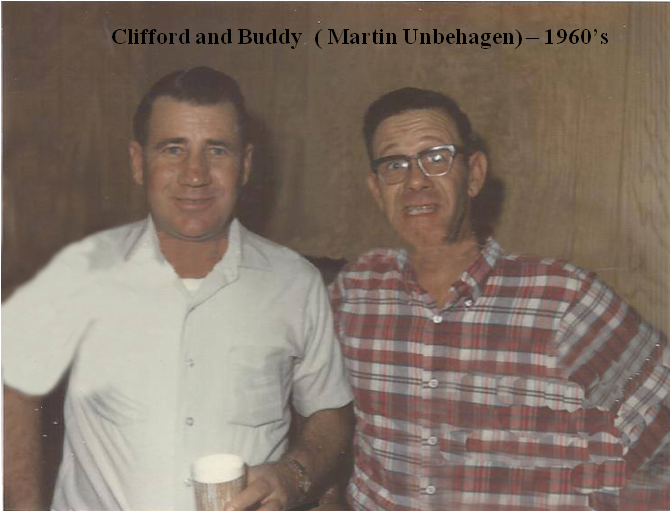


In the late  1940’s and early 1950’s Mr. Joseph (Kollo) Daigle of  Bayou Pigeon, ( Indigo Bayou)  would bring / guide  people  from  Plaquemine / Baton Rouge ; duck hunting , fishing   and crabbing  in the waterways around  Bayou Pigeon.  One of those  early folks was Mr. Phillip ( aka, P.E.) Unbehagen, who established one of the  first campsites  at Bayou Pigeon, on A. Wilbert's property in 1946 /47 timeframe. About a  ½ mile North of  Indigo bayou between  the borrow canal and Grand River.   Myra LeGrange, daughter of  Clifford LeGrange Sr.  married Mr. P.E. Unbehagen‘s son Martin (Buddy) Unbehagen in 1947.  Soon after,  Buddy built a  camp next  to his father.  Buddy and  his new brother in law, Clifford  LeGrange Jr. became  best of  friends. Bayou Pigeon naturally draws people to engage in recreational  hunting ,fishing,  and boating. Soon after, Myra’s  sister,  Margie and  husband, Edgar Eppinnet  joined  in.  Buying a camp at Bayou Pigeon  right next door to Buddy and Myra.  They were avid  fishermen.  Bayou Pigeon became the weekend getaway  for the Clifford  LeGrange Sr.  Family.   Little  did they realize in the 1950’s , how  Bayou Pigeon, LA. would  affect their  destiny.


Places  People  Remember :

“The  End of the World “ Grocery  Store, Bar,  Dancehall & Restaurant 


In 1958 , after being caught up in a ‘reduction in force’  from the Ethyl Corp. Clifford  Jr. decided to make a career and life changing event. The purchase  of the the Indigo Inn Bar and Dance hall ( aka., the End of the World) at Bayou Pigeon, La.  At the time  the combination, Grocery Store, Bar, Dancehall  was  quite common  at Bayou Pigeon.


The original Indigo Inn;   Grocery Store, Bar  and  Dancehall ...c 1956


LeGrange's  Camp -  End of the World Bar & Restaurant


Clifford  Jr. and  spouse (Joy Vicknair LeGrange)  remodeled the old Indigo Inn in stages.  The last addition added another  combination,  to the ‘Grocery Store, Bar and Dancehall’  concept. The seafood  restaurant business, selling  what we call today ‘Swamp Seafood’.  Fried catfish,  frog legs, Boiled Crawfish, Crabs and Shrimp, crawfish bisque, and crawfish etoufee.   They developed  a  facility  for private parties on a covered outside pavilion.   

Clifford LeGrange  Sr. retired in 1960  from  the ESSO refinery in Baton Rouge and  promptly moved to Bayou Pigeon to help in the business.


In the inserts, Clifford & Joy, with Carlton LeGrange on bike, 5 years old and Paw paw LeGrange 


To remove any  doubt  of whether I was reared  at  Bayou Pigeon.   
Indigo Bayou  Kids, 1962 !


After the flood of 1973 and   the death of a favorite son…The  End of the  World  Bar  and Restaurant was closed down.  Clifford Jr. built it himself , board by board and  as it was  on leased property he tore it down board  by board.   Was not able to sell it…

I was too young  and immature to realize  that the End of the World Bar and  Restaurant  at Bayou Pigeon was a rich story of family that embodies  the  Spirit of the  Atchafalaya  and Cajun Culture.   As the oldest son, I should have carried  the business on… I don’t know  what I was thinking .


Why Does remembering  Old Places Matter?  It’s  simple, Because  they help us remember! 

Memories survive  even when places disappear… The old place is gone, but  the memories  we  can keep  for our lives… Home is where your  heart is…means  that the place that you most  fondly remember,  no matter where you are,  will always have your heart.

The  End of the  World - Bar and Restaurant is  gone… My parents  are gone,  my siblings  now live in the city and most of  our old neighbors have passed or moved.  

 My ‘mother in law’  93 years  young,  this day, has lived  at Bayou Pigeon for 83 years and owns  house and property  there.  She and my Father in Law, Laury Solar (1924-1993) raised their family there.  Thus my wife is natural born  native  of there. Most of my  lifelong  friends  came from there.  Thus  I have I still have a family connection there.  I have a  Camp Boat, a Bateau, 3 Skiff ‘s and  a Pirogue… the  Sounds and ways of the Atchafalaya still  lure me in …   I live 20 miles  away…

Bayou Pigeon, LA. is where my heart is…

The  LeGrange Family -  Brand


From the days of the  “End of the  world’ , Clifford  LeGrange Jr. (1923-1995)  and  son after son have  embraced  the  Swamp  Seafood business;   from catching crawfish, selling them live , catering  large crawfish boils, processing crawfish tail meat and selling them boiled in a restaurant setting.  

From the  1970’s , until today,  all of his sons , and numerous grandsons at one time or  another have carried on in the Swamp seafood  lifeways and  culture.  From  Commercial  fishing, to  various  business ventures, eg.,  Cajun Boilers, Café LeGrange, Carlton’s  Seafood, Crawfish  City, Boiling Boys, Capital City Crawfish and  Atchafalaya  Crawfish Processing.


Cafe  LeGrange - 1980"s Acadian  Thru way Baton Rouge, La.


 2015 - Chachie  and  Carlton...Carrying on the Brand


Summary:


Clifford J. LeGrange Sr. (Pal) hailed from the Bayou Black / Gibson Louisiana area. His father was Delma LeGrange a descendant of Jean Baptiste LaGrange. Clifford Sr. made it to Baton Rouge, after service in WWI in the Marine Corps. Where he married Margie Hicks from Iberville Parish and raised his family. He retired from Esso, the Standard Oil Co. In 1960 as a / process operator / pump mechanic. After retirement,  Clifford Sr. and his spouse Margie Hicks LeGrange soon followed their son to Bayou Pigeon and helped run the  Family business. By virtue of his cajun roots “Pal” quickly became the favorite LeGrange of the cajun folks at Bayou Pigeon. 

Clifford J LeGrange, Jr. grew up in Baton Rouge and after service in WW II married Joy Vicknair of Iberville Parish and settled in Baton Rouge. He worked in the Petro-Chemical industry in Baton Rouge. In 1958 he decided to make a career change and purchased the Indigo Inn Bar and Dance hall ( aka., the End of the World) at Bayou Pigeon, La. where he had a hunting / fishing Camp. Bayou Pigeon was a cajun fishing community on east side of the Atchafalaya Basin. Clifford converted the Bar and Dance hall to a combination ; Bar, dancehall, grocery store and seafood restaurant, with a covered Pavilion and picnic grounds. There they raised there children at Bayou Pigeon. They were Clifford III ( Chachie), Cindy, Carey, Curtiss ( Rucky) , Cherie, Clint ,Carlton , Chad (Aka Charlie). Clifford and Joy introduced a new concept to the seafood restaurant business, ie., selling Boiled Crawfish in a restaurant setting. It was there at Bayou Pigeon, that the ‘Spirit of the Atchafalaya’ and the Swamp Seafood Restaurant business became a LeGrange family life long passion.

Clifford LeGrange, III, ( Chachie, the oldest)  grew up at Bayou Pigeon,  working in the family business.  At 13 years old, he cleaned catfish, frogs and started boiling crawfish, crabs, shrimp in large batches for the restaurant. He married his Cajun bride from Bayou Pigeon, Diane Solar, in 1968 at St Joan of  Arc Catholic in Bayou Pigeon, LA . 

About the Book … In 2008 , after retiring from the  Dow Chemical Co.,  he was  motivated by how much Bayou Pigeon had influenced the lives of the LeGrange's, to  research, write and publish the book “Bayou Pigeon, LA. Spirit of the Atchafalaya ‘. It was published in 2012. The book has sold 3000 copies and won a national award from the Independent Publishers association in the pictorial / coffee table non fiction history book category
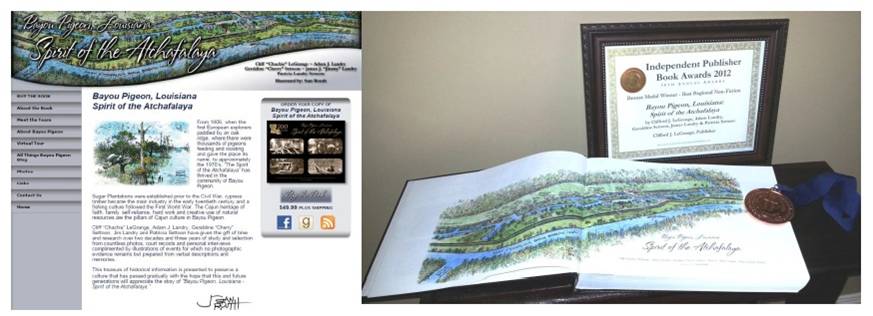


Home is Where the Heart Is ;

So  for most of you on the 'Pigeon' Facebook page and  who no longer live  at  Bayou Pigeon, I know  where your heart is or you would not be in the  Pigeon Facebook  group !

Is there any  doubt where my heart is...

Enjoy ! Chachie


Monday, December 21, 2015

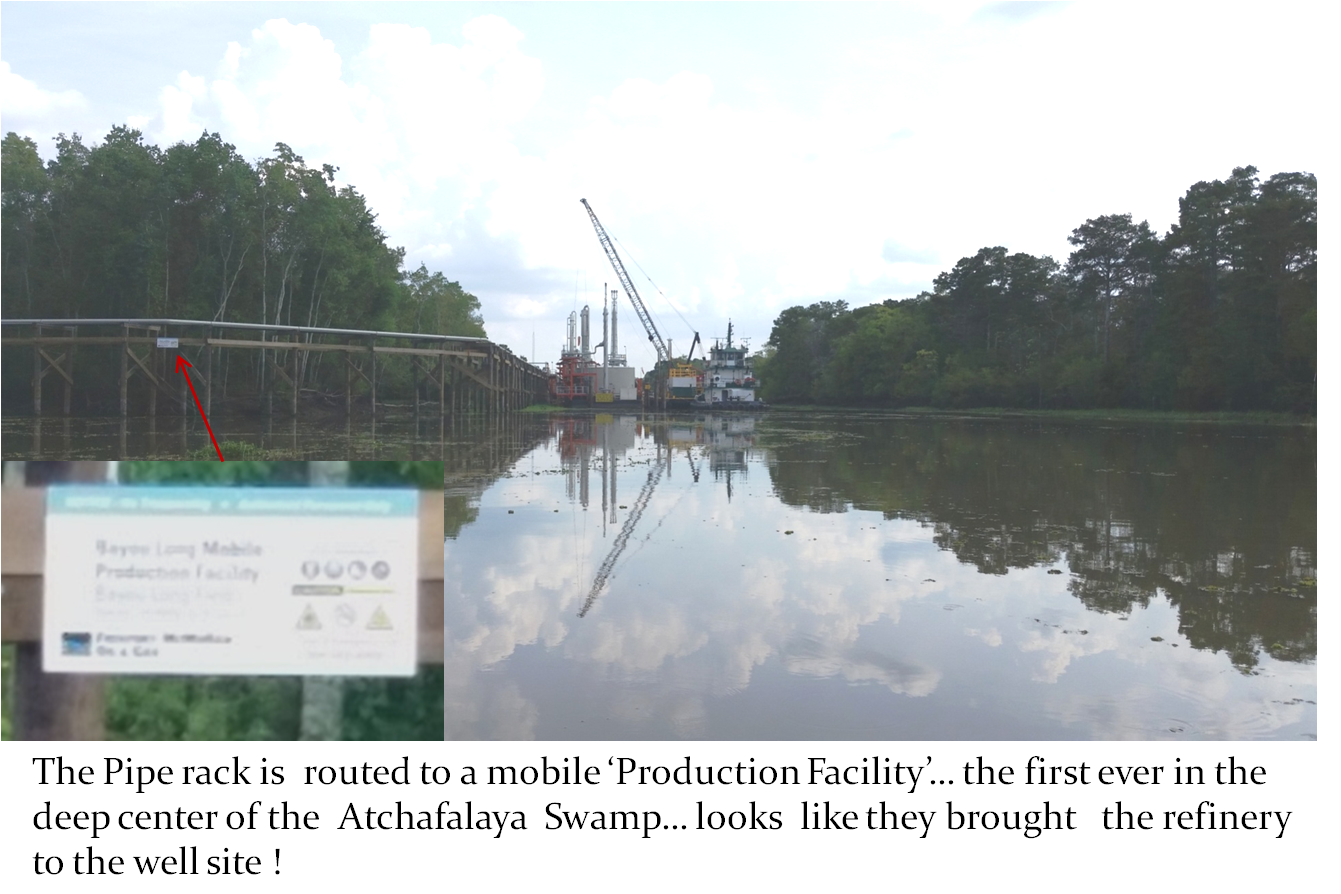
Atchafalaya Basin Oil & Gas Exploration 2015 - Ain’t like it used to be


Inland offshore  Drilling Rig 

in  the  

Bayou Pigeon _Grand Lake vector 


On Dec. 18, 2015 after 40 years of ban,  the U.S. Congress  lifted the U.S. Oil Export ban.  U.S. House Majority Whip Steve Scalise, of Jefferson Parish, Louisiana, said, “Lifting the ban will create thousands of jobs here in Louisiana and nearly 1 million jobs nationwide, while lowering prices at the pump and strengthening our national security.

This  could be a real boom  for all of  South Louisiana. but  more importantly the  levee communities  on the Atchafalaya  Basin eg., Bayou Pigeon, Belle  River, Pierre Part and especially  Morgan city.

How? Why ?


“Rising from the Ashes”


New overseas demand  may make it economic feasible  for the  deeper drilling of old oil & gas  fields. With a history of over 65 years of production, there are many old oil fields in the  Atchafalaya where the deep oil and gas potential  has not been adequately  tested. The deeper production is far better than from the original shallow wells, . 

With this news in mind, I thought I would share with ya'll  a pictorial essay on  just  such one of these wells. At the time of this drilling I did not realize this was  one those “Rising from the Ashes”oil fields. Note that deep drilling has  some safety issues to deal  with, ie., poisonous   sulfide gas  and  high pressures.


These  rigs  are towering structures !


Most folks remember the Deepwater Horizon oil spill (also referred to as the BP oil spill, the BP oil disaster, the Gulf of Mexico oil spill, and the Macondo blowout) which  began on 20 April 2010 in the Gulf of Mexico on the BP-owned Transocean-operated Macondo Prospec. Part of the problem  was the  Blowout Preventers.  In case you have never  seen a blowout preventer the above pictures is of the blowout preventers on this well.


Drilling in the Atchafalaya  Basin has gotten a lot more complicated  because it is a National  Heritage Area and covered  by  Federal 'Wetlands'  Rules and regulations.   Technology has made  drilling a lot safer.  More  drilling should require  more support services and   jobs  for our communities.  Let's  do it safely and environmental sound.

Enjoy !


Tuesday, November 3, 2015

Full Steam Ahead

Steamboats, Shipwrecks and the Bayou Pigeon


A while ago, Mr. Felix Berthelot (maybe the oldest living source of Bayou Pigeon History)  and  I were talking a little Bayou Pigeon  history,  I had my usual  questions on something that interested  me.  During the course of our conversation, he mentioned to me  a story about his neighbor, Zach Miller. 

Zach is a young guy that moved to Bayou Pigeon recently and he has a hobby of looking for and salvaging Sinker Cypress logs. Mr. Felix mentioned that Zach found a shipwreck somewhere ‘Down Below’ in old Grand Lake. 

I said, really a shipwreck!  You know, In God We Trust, All Others Bring Pictures!  One  conversation led to another ...

Which brings us to this story, “Full Steam Ahead”.  I picked up Rick Phillips and we went over to visit Zack. Sure enough, he had proof, he had stuff.  He did find an old abandoned shipwreck not that far away from what would be considered the Bayou Pigeon / Grand Lake vector.

Zach is an accomplished diver and uses scuba gear to find logs.  You can imagine he finds lots of stuff, some of it alive, when he is feeling around in murky muddy water where visibility is a few inches and you really do not see anything.


Needless to say this real life stuff got my attention; I enjoy learning about all things historic, and especially anything Bayou Pigeon, LA.   

Thus, I went back to my Bayou Pigeon  book research  data looking  for a  Corp Of Engineer's report on shipwrecks  in the Lower Atchafalaya Basin.  Research that I did not pay much  attention to  it when I first looked  at  it in 2011.  After-all, certainly there is no one alive today that can remember steam boats traveling through Pigeon.  

The only shipwreck I knew about  was the  Pogy Boat near Big Pigeon on Grand Lake... just kidding...L.O.L.  A lot of sunken  houseboats, yes, but  no shipwrecks... L.O.L. Again.


'The Ghosts of the past speaks to those that listen'


These two reports corroborates there was lot more steamboat trade the Lower Atchafalaya Basin than anyone  I know, thought.  I guess, I just thought of steamboats being on the Mississippi River passing and stopping by the big plantations.  These reports contain lots of  Information for anyone who wants to understand our history.  I recommend  them to all our history buffs out there.

The data I present below came mostly  from these two reports.


The information above is just a sample of steamboats  running the Lower Atchafalaya. 

Steamboats appeared in the Atchafalaya Basin by 1819. Traffic from New Orleans to the west side  of the Atchafalaya i.e., the Teche corridor and Opelousas, La. was heavy enough by 1827 for the new  State of  Louisiana to fund efforts to clear Bayou Sorrel and Lake Chicot  of driftwood / log rafts for  fast navigation. The first steamboats typically carried equipment and supplies from New Orleans into the sugar cane plantations in the Teche area and agricultural products out of it, or livestock across it. 

Most of the steamboat travel was from New Orleans to Opelousas / Washington, La.  and the river cities along the southern Bayou Teche, i.e., Morgan City, Patterson, St Martinville, etc.  

In 1860 there were recorded 93 steam packets operating in the Bayou Courtableau trade, and 94 in the Bayou Teche corridor.

My review of the reports yielded that there were basically 4 main routes used by Steam Boats across the Lower Atchafalaya Basin / Swamp.  

 All four of these routes went up the Mississippi to Bayou Plaquemine.  Thus the importance of Bayou Plaquemine as the main connecting artery from the New Orleans / Mississippi River to the Attakapas / Teche region is duly noted and celebrated every year with the International Acadian Festival in Plaquemine, LA.

1. Northern route - From  Bayou Plaquemine confluence with Mississippi River "follow Bayou Plaquemine past the confluence with Bayou Grosse Tete  to the Bayou Plaquemine - Grand  River (Jack Millers landing) confluence and then north on Upper Grand River, to the Atchafalaya River, and then to Bayou Courtableau to  the Bayou Teche at Port Barre – Opelousas – Washington, LA area (Gibson 1982:110-111) .  Often Upper Grand River chokes up with log rafts and debris. 

2. Middle route – When upper Grand River jammed up, a route  through Bayou Sorrel, Lake Chicot, Bayou Chene, and Bayou La Rompe to the upper Atchafalaya River Castille et al.1989:38) and then on the Port Barre – Opelousas – Washington LA  area.   Also this route could turn South at Lake Chicot go down and across Grand Lake to the Lower Atchafalaya River and on into Southern Bayou Teche near present-day Patterson. 

3. The Southern route - Accessed Bayou Teche via Lower Grand River, i.e., from the Grand River / Bayou Plaquemine (Jack millers landing) confluence southward past the Bayou Pigeon _ Grand River confluence to Bayou Long then to enter the Teche near Morgan City. 

All of the above routes were subject to become choked by log / driftwood rafts, forcing boat captains to shift to alternate routes.  


4. The Bayou Pigeon Route - Lower Grand River to Bayou Pigeon to Grand Lake entering into the middle of Grand Lake.   Where from there the steamboats could go both north to Port Barre / Opelousas or south across the lake to Patterson, LA. This route had been listed as an alternate route by some historians', however research from the Bayou Pigeon, LA. Spirit of the Atchafalaya book suggests that it may have been more than an alternate route and frequently used by steamboats hauling supplies.


Did you know there are 295 recorded shipwrecks in the lower Atchafalaya River Basin?  The tables of data  from the reports  mentioned  above, summarizes  the data  several different ways. 


Causes for ship wrecks In the  Atchafalaya Basin -  

Snag - a tree or part of a tree held fast in the bottom of a river, lake, etc. and forming an impediment or danger to navigation. 

Snagged - often in reference to steamboats caught on branches and stumps lodged in riverbeds. 

Most of the wrecks were boats caught on a snag.  One can easily imagine the paddle wheel becoming entangled with sunken logs and wrecking the paddle.

We found at least two wrecks listed that occurred on the Bayou Pigeon itself.


1842 - The wreck of the Panola 


 The wreck of the Panola just might connect some dots  for us  At Bayou Pigeon !  The Panola was engaged primarily in trade with the Washington and Opelousas area.   


What might have been  the reason the Panola was in Bayou Pigeon, in 1842?   Hmmm!

It just  so happens  that the first landowner at Bayou Pigeon, W. S. Maxwell and Susan Verami were from Opelousas.  We have evidence documenting Susan Verami at Bayou Pigeon in 1843.   See Page 73 in Bayou Pigeon Book. 

How did she (Susan Verami) get there?  Could the Panola have been bringing supplies  to build the George Mitchelltree Plantation? 


Susan Verami on  Susans Point  c 1850


1850 – Steamboat - Grey Eagle 


The steamboat Grey Eagle sank on Grand River, near Bayou Pigeon, carrying a heavy load of sugar, again maybe from the sugar plantations s of Bayou Pigeon., The Mitcheltree Plantation made 30,000 pounds of sugar in 1850.


1860 - River travel Bayou Pigeon - page 83 

We show some partial excerpts of letters from the Grace Family history, Ms Camilla Elizabeth Laughlin that corroborates the Steam Boat travel on Bayou Pigeon and the logic that the Bayou Pigeon route may have been traveled more frequently than thought.


It took lots of resources to build & maintain the 4 sugar cane plantations on Bayou Pigeon. It would have taken many trips  for all the resources needed. The letter of Elizabeth Laughlin Grace confirms that  the steamboat travel through Bayou Pigeon  every two weeks seems to confirm that Bayou Pigeon was more than just an alternate route.  Once again Bayou Pigeon demonstrates it is an overlooked part of Iberville Parish history.


The Civil War - 1864 - the USS Carabasset Steam powered Gunboat


During the Civil War, Lower Grand River / Bayou Pigeon area was patrolled frequently by steam powered gunboats.  Grand River was the western defense perimeter of  The Lafourche district of the Union command.

Capt. Jesse Miller arresting Confederate irregular at George Mitchelltree Plantation on Bayou Pigeon, see page 90 in the Bayou Pigeon book


1865 - E.H. Barmore


The steamboat E H Barmore, carrying cargo on Bayou Pigeon sank on April 1, 1865, after hitting a snag in the bayou.


The Civil War essentially ended commercial agriculture in the lower Grand River / Bayou Pigeon Region and greatly reduced the travel of steamboats in the area.  It would take the next  era of Bayou Pigeon history to bring back the steamboat, ie, Industrial Cypress  Logging. 

The Sewanee – 1906 – 1914 

The Sewanee was a wooden hulled, steam powered, sternwheel towboat built in 1904 at Patterson, Louisiana. Her hull measured 116 by 25 by 3.2 feet draft.

She was originally owned by the F. B. Williams Cypress Company of Patterson, Louisiana, and later by R. D. McKneely of Morgan City, Louisiana. 

The Sewanee towed the timber booms from the F.B. Williams Timber Camp that operated at Bayou Pigeon / Grand River from 1906 – 1914.  The boat burned at Patterson, Louisiana, on November 18, 
1932.


The Sewanee was a weekly traveler to  Bayou Pigeon for 8 years  1906 - 1914  for the F.B. Williams’s timber camp.  See Chapter 8 in the Bayou Pigeon book.  

Shown above pulling a log boom at Bayou Pigeon / Grand River.


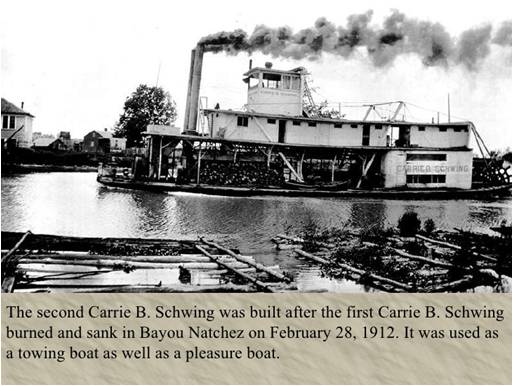
The Carrie B Schwing – 1927  

It is highly probable that the last Steamboat at Bayou Pigeon was the Carrie B Schwing in 1927. Mr. Edmond Berthelot personally told me that in 1927 a “pin wheel” boat came and evacuated the residents of Bayou Pigeon during the Great Flood of 1927. The animals rode on the bottom deck and the people on the upper deck.


The Great Flood of 1927 at Bayou Pigeon and the Carrie B Schwing by Stan Routh


Mr. Wildy Templet Cajun Historian from Pierre Part  built this  model of the Carrie B Schwing

Worth Noting! 


This story of Steam Boats at Bayou Pigeon… documents that economically and culturally Bayou Pigeon has played a significant role in the history of the Atchafalaya National Heritage Area and Iberville Parish since 1842.  Steam boats were a large part of that history.  

This is an era that is long gone and could be easily forgotten without our Bayou Pigeon book and stories like these.  

Thus was our purpose  for writing about it…Inherit the Atchafalaya and pass on the culture, history and heritage to our  children and descendants of  Bayou Pigeon folks.

Think about another thing…how many unique things  Bayou Pigeon Has to offer  Visitors...

An interpretative / educational  type center documenting the long Bayou Pigeon history and its connection to the Atchafalaya National Heritage area, Iberville Parish could be a great investment attraction for tourist and international visitors.

Enjoy !


Bibliography