Friday, February 9, 2024

Bayou Pigeon Heritage - Wallace Gaudet Family of Bayou Pigeon, LA. - Ancestry and History


Places We Remember


By Cliff LeGrange & Diane Solar LeGrange

A Family Without the Knowledge of Their Past History, Origin and Culture is Like A Tree Without Roots.

Family Histories, document and preserve family traditions and memories, the stories are what bring a family tree to life. 

Notable Quotes.

“Where did I come from”?

"You live as long as you are remembered." 

“You are what survives of you.”  

“Family pictures are magic mirrors. Like looking at your family tree of your ancestors three generations ago is almost like a ‘Ghost from the Past to You’.

Gaudet Ancestry

Gaudet’s were among the first families of Acadia and among the earliest Acadians to find refuge in Louisiana.  The first of them, four families, came to New Orleans from Halifax via Cap-Français, French St.-Domingue, in 1765.  

They settled at Cabanocé/St.-Jacques on the river, which became known as the Acadian Coast 1765 - 1820.


Two Gaudet families moved from the Mississippi River settlement (First Acadian Coast) to the upper Bayou Lafourche corridor, and which added two small lines to that center of family settlements. 

Most of their Gaudet cousins, however, remained on the river in St. James and Ascension parishes.  

Patriarch of The Gaudet Family … Jean Gaudet, Generation 1.

Jean Gaudet migrated from France to Acadia between 1630 and 1670. 

Fr. Archange Godbout of Novia Scotia, described Jean Gaudet as the Abraham of Acadia, because of his numerous descendants.

Jean was the ancestor of 10% of the little Acadian settlement, in Nova Scotia, with his two sons and two daughters, 22 grandchildren and 10 great-grandchildren. Jean Gaudet was born around 1575.


Gaudet’s arrives in Louisiana in 1766


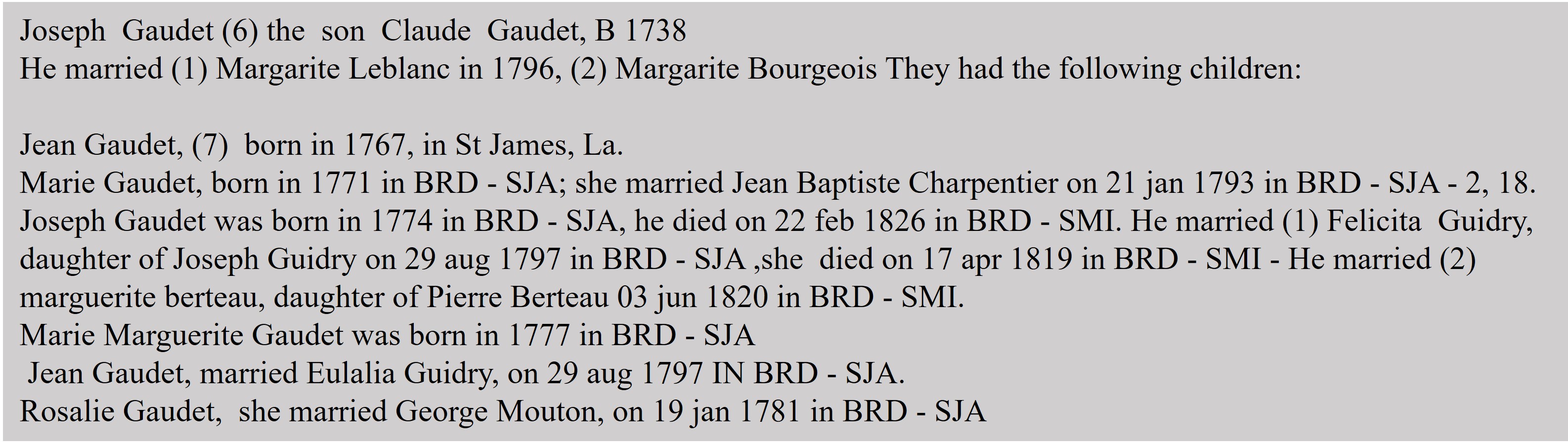
The author starts tracing the Wallace Gaudet family ancestry with Joseph Gaudet (6) born 2 Jun 1738, in Annapolis Royal; son of Claude Gaudet (5) & Catherine Josèphe Foret. 


Explorations and scattered settlements in the 17th and 18th centuries had given France control over the Mississippi river and title to most of the Mississippi valley.

The first serious disruption of French control over Louisiana came after the Seven Years’ War (1756–63), the last major conflict before the French Revolution to involve all the great powers of Europe.

In 1762 France ceded Louisiana west of the Mississippi River to Spain and in 1763 transferred virtually all of its remaining possessions east of the Mississippi River in North America to Great Britian. 

The Acadian Coast was a name which is applied by historians to the section of Louisiana along the Mississippi River that was settled by the exiled Acadians, beginning in 1764 to 1785. 

The First Acadian Coast was 20 leagues up from New Orleans on both sides of the river.

Joseph Gaudet (6)

Joseph Gaudet (6) arrived in New Orleans, Nov. 1766, with wife Marguerite as part of a group of 216 Acadians to arrive in Louisiana from Halifax, Nova Scotia as part of the Grand Derangement. 

They were given cattle, tools, provisions and were located on the banks of the Mississippi river in St James and Ascension Parish.

In the St.-Jacques, LA. (St. James) census of 1777, a Joseph Gaudet was counted as, age 38, lived with his wife Marguerite age 33, sons Jean aged 10, Joseph age 2, daughters Rosalia age 13, & Marie age 5. 

Two years later, in the St.-Jacques census, 1779, Joseph was listed again, along with 7 other unnamed whites, 2 slaves, 6 qts. rice, 10 qts. of Corn. 

French power rebounded under the subsequent military leadership of Napoleon Bonaparte, and on October 1, 1800, Napoleon induced a reluctant King Charles IV of Spain to agree, for a consideration, to cede Louisiana back to France. Confirmed March 21, 1801.


The Acadians who lived there were called ‘les petits habitants” (Small Farmers) by the French and Spanish settlers. Most “les petits habitants” grew crops that satisfied their own household needs for food and clothing rather than grow crops to sell on the market. 

The 'Petits Habitants' migrated to Acadia (New France) to find a better life. Which was disrupted by the English when they took over Novia Scotia and enacted the Grand Derangement.


Grand Derangement 


The Acadians had lived on Nova Scotia’ territory since the founding of Port-Royal in 1604.  Largely ignored by France, the Acadians grew independent minded. After the British gained control of Acadia in 1713, the Acadians refused to sign an unconditional oath of loyalty to become British subject.

Once the Acadians refused to sign an oath of allegiance to Britain, which would make them loyal to the crown, the British Lieutenant Governor, as well as the Nova Scotia Council on July 28, 1755, made the decision to deport all the Acadians.

Eventually 2500 Acadian families made their way to Louisiana 1764 -1785.

The Acadians were agricultural people. They sought solace / contentment in Louisiana after the Grand Derangement.

St. James was settled during the era of Spanish dominance 1762 - 1801. 

The Acadians were attracted to Louisiana because of the French people living there.  

With so many Acadians arriving in Louisiana, Alejandro O’Reilly, Louisiana’s second Spanish governor set forth new rules which applied to land grants and settlements along the Mississippi River north of New Orleans. 

The land had to be surveyed and approved by two local witnesses. 

The applicants had to build levees to protect from floods, dig ditches along the levees to ensure drainage, and layout a public road along the river.


Louisiana Purchase 1803


Napoleon Bonaparte sold Louisiana to the new United States in 1803. 

The new United States ‘English Speakers” wanted to exploit the lands along the banks of the Mississippi River (the Acadian Coasts) i.e. to grow crops to sell to markets. 

The new Americans had the cash to buy the land from the poor Acadians.   

There was not much resistance to sell their lands as the Acadians disliked the English-speaking Americans.  

They did not trust the English-speaking government. After all the British had just kicked them out of “Acadie”, i.e. the Grand Derangement.  

Besides, they struggled to maintain the new requirements which cost money.  Which were required by law, they hated debt and sold their land to get out of it.

Pitot, James (Pacques François), the Spanish Cabildo Ward Commissioner of New Orleans, wrote a critique of Spanish rule of Louisiana colony in 1802-1803. 

He noted “With the growth of Assumption Parish, the les petit habitants withdrew into the interior reaches of the swamps”.
 

How Did the Wallace Gaudet Descendants   Get to The Pierre Part Belle River Area ?  


Via Joseph Gaudet (6) 


This movement to the interior of the swamp followed two migratory paths.  

From the ‘First Acadian Coast’ to the Upper Bayou Lafourche Valley (red) to the Atchafalaya interior to Pierre Part, Belle River, Lake Verrett via Bayou McCall and Grand Bayou.

From the Lower Bayou Lafourche, (green) via the Plattenville / Paincourtville, Napoleonville area via the Attakapas Canal.   

Note this route was also used by Acadians / Cajuns from the   'Acadian Coast' to   get to the 4 Mile Bayou and Stevensville and Bayou Boeuf, via Lake Palourde to Morgan City.


The Route to Pierre Part


There were some crude trails / paths along natural alluvial bayou ridges and through the higher parts of the Atchafalaya Basin. 


At the Village of Port Barrow on the banks of Bayou Lafourche slightly below Donaldsonville, Bayou McCall leads to Grand Bayou, which led to Lake Verret.


By 1815, a small settlement of families existed on the banks of Lake Verret, near where Bayou Pierre Part flows into the Lake Verret. 

The interior bayous offered the poor man an opportunity to breakout of the social hierarchy of the 'Front' (Bayou Lafourche Corridor) and work for himself. 

Many Acadians disliked the Spanish interference in their daily lives and wanted their progeny to live adjacent to land they owned which had become unattainable on the congested Front of Bayou Lafourche.

Other ethnic groups entered the back swamps and bayous of the Atchafalaya interior as well (e.g. Islenos from the Canary Islands); however, most were eventually subsumed by the dominant French Acadian culture.


During the antebellum period, 1820 – 1860, Joseph Gaudet (6) and his first wife Marguerite Bourgeois moved from St. James Parish on the Mississippi river the Acadian Coast to the Bayou Lafourche area to Napoleonville   / Plattenville, LA.  near the Attakapas canal.

Eventually they somehow made it the Pierre Part / Belle River area. Most probable route to Pierre Part / Belle River was by boat through Lake Verrett. 

Why did they choose Pierre Part / Belle River? 

Essentially there were slivers of land (the natural Alluvial Ridge) of Bayou Pierre Part and Belle River for farming.  

It was the furthest west you could go that was not subject to extreme flooding in the annual flood pulse.   

Jean Gaudet (7th) The Son of Joseph Gaudet (6) b 1767


Pierre Gaudet (8) The Son of Jean Gaudet (7) b 1738 


Pierre Gaudet and Delphine Stoute Gaudet are buried in Belle River cemetery.

Francis Numa Gaudet (10) b1862 – d 1937; The Son of Pierre Gaudet (8 th)  b 1738, Father of Wallace Gaudet.


1910 US Census – Finds Numa Gaudet is living in Pierre Part, La.

Numa Gaudet occupation was listed as a Swamper  and his son Wallace occupation was simply listed as ‘pull boat’, which meant he was working in a industrial Cypress Timber Camp.


Numa and his spouse Victoria Vaughn Gaudet and spouse Buried in Belle River, LA. Cemetery.


Victoria Vaughn Gaudet                          Numa Gaudet


Wallace Gaudet (10) b 1889 d 1961; The Son of Numa Gaudet (10th) 


Wallace Gaudet spoke and could read and write in both French and English. He had a basic education. 

There was a school at Pierre Part in the very early 1900’s.  
Special Note:  Wallace’s future wife Celestine went to the same school. 


Mr. Wildy Templet, renowned historian of Pierre Part related to me that after the Industrial Cypress Timber industry ran out of Cypress to cut. The Timber Camps went away in the late 1920’s.  

Wallace Gaudet opened a retail grocery business along Pierre Part Bay. 

In those days people set up a booth type store front on the water and sold goods to people traveling by boat in the waterways. Waterways were the highways in that era.

Wallace and Celestine Family


Wallace and Celestine on wedding day


Wallace and Celestine, Gibson, Johnson, Emmeline & Ed 1922


When the great Depression came in 1929 / 30, most of those small businesses went away, there were no jobs and no money to be made. 

Wallace with 3 other Cajun Families, Joseph Daigle, Cashmere Solar, Durcroseille  Blanchard  moved their families from Pierre Part to Catfish Bayou area on Grand Lake,  

In search of less crowded fishing waters.  There they eked out an existence of living off the land. 

They literally had to catch, kill, or grow their next meals. Selling off any surplus of fish and game and picking moss to earn whatever money they had.

Wallace and family remained at Bayou Catfish for approximately 5 - 6 years.  

Sometime in 1936, Wallace moved his family from Catfish Bayou / Grand Lake to the Indigo Bayou hamlet in Bayou Pigeon.  

There were other reasons as well for the move. 

The new Atchafalaya Floodway levees were almost complete. 

With that the Corp of Engineers would be closing off all east access channels from the Atchafalaya River into Grand River flood plain. 

Cutting off boat traffic from to east side off of the basin by closing the channels of Upper Grand River/ Bayou Plaquemine, Bayou Sorrel, Bayou Pigeon, Old River, Bayou Pierre Part, The Godel, Belle River, Lake Verrett, Lake Palourde, and Atchafalaya River at Morgan City.

In 1936 that was mind boggling change for the commercial fishermen / swampers. In 1936 there were no boat trailers and launching ramps. 

Also it meant, Swampers living in the interior of the Natural Atchafalaya Basin would be exposed to extreme floods since the new levees containing the annual flood pulse to inside the levees were 25 ft tall.

Their final reason for abandonment of the center of the swamp was Celestine was about to give birth to Shirley and the family moved for the birth.

In 1933 two shell roads were completed from Donalsonville to Bayou Pierre Part and Bayou Sorrel to the Bayou Pigeon School.  

Which provided road access to hospitals and town. 

Many swamp dwellers did not want to move   from the only living they knew, i.e. following the resources of the swamp. In the end, many families did not move very far, they moved to communities on the edge of the new levees.


The out migration followed predictable paths, the French speaking Cajuns migrated to areas where French was dominant culture and the English-speaking Anglos (Americans) to one where Anglo / American culture was dominant. 

After 100 years the Cajuns still not trust English speaking people.  

On the east side of The Atchafalaya Basin, the Cajuns migrated to existing French speaking enclaves, i.e. Pierre Part /Belle River and Bayou Pigeon. 


Wallace loaded all his worldly belongings on a wooden barge, pulled by a putt putt boat owned by Dewey Burns and made the trip to Bayou Pigeon which had small homogeneous population of Cajuns. 


Wallace Gaudet - ‘Gone to Pigeon’ 1933 / 1935. 

There he reassembled his house (not much more than 4 walls) at Indigo Bayou on the west side of the new road built in 1932 / 33. His last two children; Shirley and Hilda were born there.


Bayou Pigeon Community After the East Atchafalaya Basin Protection Levee (EABPL) Was Completed

When Wallace Gaudet moved to Indigo Bayou, Gipson, Johnson, Raymond, and Ed were still living at home. 

The Gaudet boys were expected to work and contribute to household income and the two older girls Emmeline and Beulah were to help their mother with the household chores.  

The two youngest girls, at that time Veri and Mildred went to the Bayou Pigeon School.

Between 1945 and 1947 Wallace’s oldest son Gipson, and his third son Ed, bought the Cleveland (Bee) Landry Grocery Store. 

The store was about 1.2 miles in distance from Indigo Bayou in Bayou Pigeon. The store was between the road and Borrow Pit Canal. 


Johnny Settoon, Nolan Settoon and Clement Landry with his back to Camera c 1941 


This picture showing the Dock at Cleveland (Bee) Landry store in the Borrow Canal paralleling Hwy 75 at Bayou Pigeon later purchased by Wallace Gaudet’s General Store.  Is an iconic picture of the folklife and folk boats of Bayou Pigeon.


Johnson Hedges, Evis Hebert, Curtiss Leonard
another iconic picture of Bayou Pigeon folk life c 1940's

The Gaudet’s added a barroom / dancehall to the General Store. Wallace and Gip would travel to the store by boat from Indigo Bayou until they purchased an old truck. 


Gaudet Bar & Dancehall c 1950's


The Gaudet store along the Hwy 75


Irvin Settoon, Lucy Settoon, Mildred Gaudet, Violet Settoon, Irvin was courting his future spose, Mildred, mid 1950’s at the Dancehall.

Gibson Gaudet first son to leave the Nest.

Gip married and moved to Pierre Part and pursued Timber and Oil field work but kept his share of store ownership. Gip went on to be a prominent resident of Pierre Part, becoming the first Volunteer Fire Captain. 

After Gip left, Wallace took apart their old house at Indigo Bayou. 

The house was reassembled / added on to it and located on the Eastern side of the Hwy. 75 across from the Gaudet Store.


The store was a typical country general store, they kept many of the supplies needed for bayou living. Large sacks of flour, coffee, coal oil for lamps, feed for animals. The store also bought fish and moss from people. In the 1940’s most people came to store by putt putt boat.

In the 1950’s Wallace and Ed purchased an old green pickup truck and started a grocery delivery service


The Old Green Pick-Up Truck Hauled Moss, Mr. Ed Gaudet delivered to moss gins.  They Delivered Groceries A One-Of-A-Kind Delivery Service


The Gaudet family provided a one-of-a-kind service to their customers. Each morning Shirley Gaudet would take the old green truck and make the round to all the houses on the route and take orders. 

Return to the store place the goods in bags or boxes and then make the deliveries, every day but Sunday. 

The Gaudet Store customer base was south from the store to Indigo Bayou, on both sides of the road. They did not cross Grand River to deliver groceries. 

At a time when very few people at Bayou Pigeon had a automobile, this was a great service to residents of Bayou Pigeon. 

People purchased most of their groceries, every day and only bought what they needed for the day, i.e.., no refrigeration! 

Shirley Gaudet was the ‘pillar’ of the Gaudet grocery store doing all the heavy lifting of taking the daily orders, packing the groceries in the bags, and delivering. She was known for carrying 100-pound sacks of animal feed from the truck to the steps of each house.

Shirley and Wallace ran the Grocery store and Ed Gaudet ran the Bar and Dancehall, there were live bands on Saturday night and on Sunday afternoons. 

Even then Shirley took care of many of the customers, folks remember Shirley opening the store after the dance to fix lunch meat sandwiches for the customers who needed something to take them home.


Wallace opened the store every day and waited on customers. The store was open 7 days a week.

The Gaudet store was always looking to make a buck !

Reel to Reel  Movies at Bayou Pigeon

In the late 1940’s and early 50’s Mr. Adam Landry and his cousin Jim Landry related that the first movie they ever saw was at the Gaudet dancehall.  Ed rented a reel-to-reel movie machine and screen and showed the first movies in Bayou Pigeon. The adults sat on benches and chairs and the kids sat on soda bottle cases or on the floor. They were charged 25 cents to watch a movie.


1958 Brought Major Changes

In 1958 the State of Louisiana paved the clam shell road from Bayou Sorrel to Bayou Pigeon. It so happens that parts of the Gaudet store, Bar and Dancehall were partially in the roadbed and had to be moved.


Gaudet Grocery, Bar & Dance Hall separated and relocated to east side of new black top paved road c 1960’s


Wallace Gaudet passed in 1961.


He never worked in the Grocery store when it was on the east side of Hwy. 75. 

The body viewing (wake) was done at his house and the body was never left alone until the burial. 

Shirley, Hilda, and Anite Hebert Gaudet, spouse of Edison Gaudet worked in the grocery store after Wallace passed and Ed Gaudet operated the Bar and Dancehall.  

Hilda retired from working in store when she got married in 1962.

In retirement Wallace spent most of his time entertaining his many grandchildren.

 The Gaudet Store, Bar & Dance Hall, closed permanently in the 1964-65-time frame.


Wallace Gaudet with two of his Granddaughters
  Irene Gaudet and Hazel Gaudet, 
Children of Raymond Gaudet and Alma Aucoin Gaudet
On the porch of his house on east side of HWY. 75


About Wallace, B 1889 – D 1961; pronounced ‘Wa_les’ (emphasis on both syllables)

Wallace was the typical Cajun man, i.e. children lived at home until they married. 

Wallace was living at home at 20 years old working in the Cypress Timber camps in the Pierre Part / Belle River area. Wallace must have married shortly after 1910, after marriage we surmise, he transformed to a retail merchant, along Pierre Part Bay which set the stage for his eventual entrance into the grocery store business at Bayou Pigeon. 

Wallace was the typical Cajun Husband / father, i.e. men made all major decisions in their home.  

When the Gaudet family pulled up stakes in Pierre Part and moved to Catfish Bayou on Grand Lake we are sure he made the decision. 

In those times Cajun men did not put a lot of emphasis on formal education.  They emphasized the teaching of Swamper  skills  for the boys and Domestic skills for the girls was left to the mother.  

An explanatory note, it was not until 1916 that school attendance up to age fifteen became compulsory, and then the law was not rigorously enforced until 1944.  

While living in the interior of the Atchafalaya Basin, Wallace Gaudet’s older children did not have opportunity for school.

Wallace is buried in Pierre Part, SJPP cemetery.


About Celestine Hebert Gaudet b 1895 – d 1973; shorten Tine.” 

Cajun women of Celestine’s day were to be virgins when they married.  They were to bring up their female children to respect and follow heritage and traditions. 

She was to keep the children fed  with delicious meals and  clean clothes.  Her house was to be spotless  with fresh linens.  

Cooking utensils were to be neatly organized and in place when not in use. 

Children were not allowed to sit on beds.

By way of her children and Grandchildren we can say with certainty, that Celestine managed to do all those things very well. She always seemed perfectly content in her role as homemaker. 

She went about her day in a calm and peaceful manner, never rushed demonstrating patience and never raising her voice!

I have been told by my spouse and her other cousins, that Gram would get down on her knees and say her bedtime prayers every night.  

Her Grandson, Chris Settoon related first-hand knowledge that her nightly ritual was not only her bedtime prayers, that she would light a candle in the window and recite her rosary and then move to her bedtime prayers. 

The woman was a saint.


Celestine Hebert Gaudet, “Gram” is buried in Pierre Part, SJPP cemetery next to Wallace her lifelong Spouse.


Gaudet family reunion c 1990's 

Wallace and Celestine are buried in Pierre Part, LA. at SJPP cemetery as well as most of their children. At the time of this writing the only surviving child is Hilda Gaudet Leblanc.


The LeGrange Connection


   1947 and 2017 … Beulah Gaudet Solar mother of Diane Solar LeGrange 2021

Diane Solar LeGrange, spouse of Cliff (Chachie) LeGrange, publisher / author of Bayou Pigeon, La. Spirit of the Atchafalaya and granddaughter of Wallace Gaude.

Diane would make deliveries with her aunt Shirley Gaudet to customers at Indigo Bayou on Saturdays … visit with her cousin Beverly Gaudet and uncle Johnson and Aunt Verner in Morgan City during summer ...memories that will last a lifetime…
 
Wallace and Celestine with 10 children had plenty of grandchildren and great children. Many Grandchildren and great children are still in the Bayou Pigeon area today. 

Preserving the Heritage, Wallace Gaudet Family

If We Know Where We Came From, We May Better Know Where To Go.

If We Know Who We Came From, We May Better Understand Who We Are.  

With 10 children, 41 grandchildren, 33 great grandchildren at the time of their deaths, Wallace and Celestine left a large legacy.

Every one of us is passed a heritage. We pray that the heritage we pass on to our descendants is the good stuff.

Wallace left the legacy of the Gaudet General Store, Bar and Dance Hall and the many customers they touched.  Buying fish and moss from their customers and providing credit at a time when many of their customers lived day to day.

Celestine left a legacy of how to live a role model life of a Cajun wife and homemaker ie, God & Family first attitude. 


Gaudet Collage


About the author

Cliff & Diane Solar LeGrange, met in 1965 at the ‘LeGrange’s End of the World” Grocery, Bar, and Dance Hall and married in 1968.


LeGrange’s End of The World Grocery Bar and Dance Hall C 1959


LeGrange’s Camp, End of The World, Grocery, Bar Dancehall and Restaurant c 1964

T

he river communities Along the Eastern Atchafalaya Basin, ie. Ramah, Bayou Plaquemine, Bayou Sorrel, Bayou Pigeon Pierre Part, Belle River, Stevensville are known for Their Folklife and Traditions of The Bayou  Cajuns.

There are fewer young people taking of life of full time swampers / fisherman. Old folklife and traditions are fading fast.  

Be that as it may  the memories that were made are still very precious to the people of the area. Even though they choose live in suburbs closer to their work. 

Today many of those people are buying old homes in the area as Camps to keep a connection to that way life, i.e. the Bayou Cajuns.

The Bayou Pigeon Heritage Association is trying to play a small part in keeping folklife, traditions  alive with our Folklife museum.

Come visit us…

Open by appointment M – F

Contact: BayouPigeonHeritage@gmail.com

Or just give us a Holler1

225 776 2686
225 385 1050
225 385 5494
225 385 5217


Wallace Gaudet Family Ancestry and History
By 
Cliff (Chachie)  LeGrange and Diane Solar LeGrange, 
Sept. 2020, Revised 2 7 2024


Tuesday, January 16, 2024

Mr. Calvin Leblanc - No Myth , the Real Deal Music Legend


A Man of Integrity and Friend to All at Bayou Pigeon

Bayou Pigeon has lost another irreplaceable member of our Community.

Calvin Pierre LeBlanc passed away on Tuesday, January 16, 2024 at the age of 86. He was a native of Pierre Part and lifelong resident of Bayou Pigeon. 

He was the son of Walter and Zelmire who moved to Bayou Pigeon in 1942. Together they raised their eight children in Bayou Pigeon. 

Mr. Calvin experienced all the elements of Cajun folk life. He was an Army Veteran, a commercial fisherman, ran a truck route business, and was a union pipe fitter in the construction industry, worked with wholesale crawfish buyers picking up and delivering crawfish to retail outlets all over South Louisiana. He was known and respected by every resident of Bayou Pigeon when he ran his truck route business selling fruit, bread, meat and ice to the residents of Bayou Pigeon.

Calvin was attracted to music at a very young age. He began by listening to the Grand Ole Opry on the radio on Saturday night at his Uncle Ernest Hebert’s house. He would pick up a broom and used the handle as a neck of the guitar and the straw as the body and imitate.


For two of Walter and Zelmire children, Calvin and Roy, music has become a life-long passion. They are self-taught musicians, with Calvin’s son, Kerwin following in his dad’s footsteps, playing, writing and recording his own songs and a CD. Calvin’s fondest times were playing music with his family members, especially his son, Kerwin, and his brother, Roy.


Roy Leblanc, Calvin Leblanc, Kerwin Leblanc playing at the LeBlanc Family Reunion.


Calvin, Kerwin and Roy playing and singing at a Bayou Pigeon Spirit of the Atchafalaya Book signing event.


With his lifelong friends, Adam Berthelot and Alcide Berthelot, they played music at many types of venues, bars and dance halls and weddings.  

Calvin and his band play what we call Bayou Pigeon Dance Hall music, i.e., rhythm, guitar, bass guitar and drums. The music is a hybrid of Rock and Roll, Country and Western and something called rock-a-billy. This style of music was the staple of small town dancehalls. Alcide played the lead guitar, Adam played bass guitar and Calvin was the lead vocalist and played the rhythm guitar.  They were swamp pop before swamp pop existed.


In later years Calvin and Adam, played pro bono at St. Joan of Arc Church Fairs, and sang gospel songs at St. Joan of Arc mass and Nursing homes for elderly.  

Our team Bayou Pigeon Spirit of the Atchafalaya book team was lucky enough to have Calvin join our team. Calvin played music at over a dozen Bayou Pigeon Spirit of the Atchafalaya book signings.  


Calvin Playing at Pierre Part Library, where part of the presentation was that he and Adam Landry only spoke in French to the delight of Cajuns in the audience.  They brought that Cajun kinship to the forefront
 

Two of our audience's favorite songs, were Pauvre Pecheur (Poor Fisherman)   by Roy Leblanc and Bayou Pigeon by Lou Millett whom Calvin knew personally.


Our Book team playing for  the Landry’s (of the Swamp People) at Troy Landry’s home, was another highlight.


Calvin Leblanc, his life was about Bayou Pigeon Kinship, God, Family, Friends, and Cajun heritage. 


R.I.P. Calvin we are sure that you are playing music in Heaven with Roy, Adam Berthelot and Alcide Berthelot.

Ton ami 

Chachie and the Bayou Pigeon Spirit of the Atchafalaya Book Team


Sunday, July 2, 2023

 LE FEU FOLLET

When writing the book, Bayou Pigeon, LA. The Spirit of The Atchafalaya.

Mr. Felix Berthelot, a  walking history book in one of our talks, about Bayou Pigeon history, Ghost stories came up, he said have you heard ‘Le Feu Follett’.

If you were deep into the swamp, alone on a moonless night where the darkness holds sway. If you were lost or just poling your pirogue back to your camp boat, sometimes you would see lights that seem to be following you along on the ridges, if you went to shore, they would move back in swamp and where the ‘gator and the water moccasins and other bad things lived.

He said these lights were ‘Le Feu Follett’ the Ghosts of the Swamp.

He said if you tried to follow them you would die.

I had never heard of ‘Feu Follet.

So I thought I might ought to research that topic… here is that story.

The Feu Follet is said to be glowing balls of light or flickering balls of light randomly dancing in the dark shadows of the bayou.


A ghost legend, evil entities, they were Evil spirits looking for souls to steal. Laying a trap for those unsuspecting swamp travelers who were unlucky enough to stumble upon them.

The balls of light were thought to be a distraction by the entity in hopes that someone would be drawn to the balls of light, follow them deep into the swamp, and eventually get lost or drown.

Feu follet (foo fow-lay) is a Cajun French phrase which translates to “marsh fire” or “crazy fire,” depending on who you talk to.

The phrase comes from the Acadians. Cajuns today say that their grandparents and ancestors before them used to tell stories that on the darkest of nights, you could see mysterious lights. They’ve supposedly been seen in different sizes, but some say the average size is said to be no larger than a candle flame.

Some old Cajuns thought they were souls who escaped from Purgatory or they’re the souls of babies who were never blessed in the Church.

Cajuns believed that since unbaptized babies carry sin but are still free of wrongdoing, they cannot go to heaven or hell, and their souls stay on earth, sometimes appearing as Feu Follet.

According to Cajun lore, if you tried to follow them, once they lured you into following them, they turn you around and it would look like they were coming to get you.


Adding the fact that the Atchafalaya swamp at night can be a cacophony of noises, from frogs to alligators bellowing and everything in between.

Or it can be eerily silent with nothing but the sounds of your paddle plying the placid, muddy waters. Add the soft touch of Spanish moss on your head or the dropping into your pirogue of one of the many resident snakes and the Atchafalaya can provide quite a scare.

Some old Cajuns believe if the Feu Follet got after you, by sticking a piece of iron, ie., a knife into the ground will distract the Feu Follet would begin playing with the knife and leave the traveler alone.

As the mystery of this phenomenon became more prominent naturally it would eventually lead to the requirement of some sort of explanation.

Over the years many explanations for the lights have been offered, ranging from an electrostatic discharge, swamp gas, or moonlight shining on veins of ghosts.

The most plausible explanation is that the lights are an unusual phenomenon similar to a mirage, caused by an atmospheric condition produced by the interaction of cold and warm layers of air that bend light so that it is seen from a distance but not up close."

Whatever Mr. Felix told me he believed in the Feu Follet.

Back in the day his father told him he knew people who said they saw 'The Feu Follett' frogging on / in the Long View around the confluence of Little Bayou Pigeon / Big Bayou Pigeon.

That if he ever were to see them never try to follow them or he would die.

In modern times some may say, the Feu Follett is finally seeking revenge for the many who have done harm to or in in the Atchafalaya Basin over the years.

Is it the litterers who throws there trash in the waters and on the land, is it fossil fuel exploration that takes shortcut does not follow guidelines established per the permits, is it the outlaw head lighter who is hunting game at night, is it the fisherman who may be running another fisherman nets / crawfish traps, whatever, either way, if you for some reason find yourself in the Louisiana swamp at night…don’t follow the light.

Enjoy


Monday, April 24, 2023

 Mr Floyd (Cubbie) Landry & His Wife Mamoo


Ms. Amy T Landry Denehy lives at Bayou Pigeon and is now a one of our active members of the Bayou Pigeon Heritage Association. 

Many members of the Bayou Pigeon Heritage Association may not know where the deep ties to Bayou Pigeon come from.

This is that story.


Floyd (Cubbie) Landry was original from White Castle, La. he was the owner with his brother Lucien of Landry Glass in Brusly, LA. 

Cubbie established his first camp Bayou Pigeon in 1954.

The first camp was an old Baton Rouge city bus remodeled and brought to Bayou Pigeon. 

They added on to it in 1956,

This was before the existing pontoon bridge was built. In the era of the Bayou Pigeon ferry. 

Sometime around 1963 they built a brick veneer camp.  Some people say that was the first brick house at Bayou Pigeon.

Mr. Cubbie, (like most campers back in the day) had two close friends who were native born Bayou Pigeon residents who looked out for him. It was quite common back in the day for the native Bayou Pigeon Cajun folk to strike up close friendships with campers.

Mr. Edmond Berthelot who ran the store front at Bayou Pigeon and Mr.  Monroe Settoon who lived directly across Grand River from Cubbie’s Camp.  

Cubbie had a running account there where the Landry kids could go to the store and get supplies.

Mr. Cubbie  could be seen coming around Mr. Edmond’s crawfish dock every weekend during crawfish season.  Where he would always pick out the two crawfish sacks with the biggest crawfish.  Even when Mr. Edmond wasn’t there,  he would pay for it when paid his bill.

Amy T says another good  friend  of Mr. Cubbie was  Mr. Clevin (aka., Mustache) Berthelot.  He always would get freshwater crabs in season.

Alex Landry, Mr. Cubbie oldest son says he remembers Mr. Monroe would transport the Landry’s from west side of Grand River to the east side before the Pontoon Bridge was built.

Amy T tells the story of her brothers helping her mom (Mamoo) up the old high levee of Hwy 75 before it was paved, to go to church at Pigeon on Sundays.

By far, what Mr. Cubbie was known for at Bayou Pigeon was his 1967 Speed -Liner boat.  It was the fastest boat at Bayou Pigeon. It was a mahogany wood boat he always kept it in tip top condition.  It was the custom-built boat of the 1960’s.


Cubbie Landry & at the wheel of the Speedliner


Alex Landry says Mr. Cubbie and family spent a many Sunday evening at the LeGrange's “End of the World’ Bar and Dancehall . Eating crawfish at the restaurant and / or on the picnic grounds.


Mr. Cubbie passed in 2003, but his legacy at Bayou Pigeon is carried on by Amy T and The Bayou Pigeon Heritage Association.

Preserve the Heritage !

Enjoy !


Friday, July 29, 2022

What's in a Door?

 What's in a Door?  Well, sometimes a lot ...

Vintage doors possess a majestic beauty and history

While the history of doors may seem trivial. It is not, however, uninteresting.

For instance, how large was the door on Noah’s Ark? Okay, we really don’t know. But if we did know, would we possibly translate the variable measure of a cubit? 

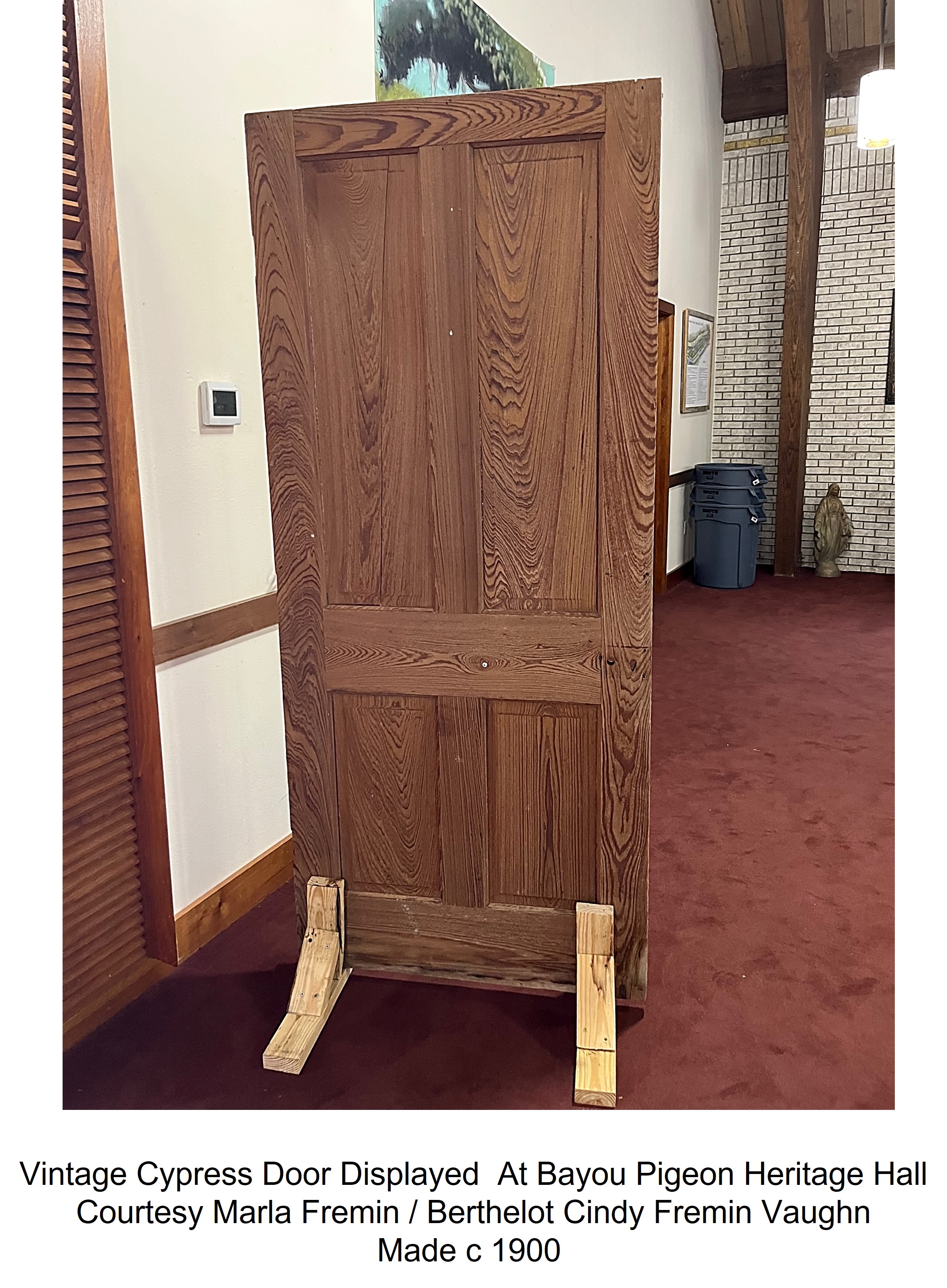
The Bayou Pigeon Heritage Association now has two vintage cypress panel doors on display in our Heritage Hall.   Courtesy of Marla Fremin Berthelot and Cindy Fremin Vaughn. 

Panel doors, with a classic pattern of square / rectangle panels were/are one of the most common type of doors seen in upscale classic homes today.


 What's in a Door?

History buffs and local historians are always excited about learning the hidden history of things, places, and or events.  

Even things some folks might think are trivial, like a door.

In this case a door is a little piece of the history of White Castle


When the Fremin family of White Castle purchased the land where they built their Diner, they purchased the old  house  that was on the property.  

They had it torn down and salvaged the old vintage cypress doors that were in the house. 

Mr. Leonce Soniat was a large landowner in the White Castle area in the late 1800's and owned what is now Ceder Grove Plantation which touches the west boundry of the Town of White Castle.  

When the town was incorporated in 1892, he purchased several large plots in what is now the Town of White Castle and one of those plots was where the old Diner was located in White Castle.  

He built and owned several homes in that neighborhood. 

The house originally belonged to Paul Blanchard a rather wealthy businessman who was co-owner of the first movie house in WC with Eddie Barbay.  

The house was later sold to Mr. Pete Gauthier who owned the second movie house in WC located on the north side of the RR track in WC.  

He rented the house in later years and one of the long-time renters was Mr. E. J. Burleigh a county agent who lived in WC. 

Researching the history of the house and the doors with Mr. Fry Hymel, talking with some of the old timers from the area, we can be sure the original house was built in the very early 1900's.

While it is probably lost to history where Mr. Soniat got the cypress lumber to make cypress doors in the house he built.

It is almost certain that the doors were made from cypress produced and milled at the local White Castle Lumber and Shingle Co. Mill the Cypress Queen.  


The White Castle L&S Co. shut down in approximately 1915.  


Layout and Location of the White Castle L& S Co.


Almost Lost History

It is amazing how fast the history of something can be lost in a relatively short period of time.  Many examples exist that have shown how quickly and completely history can be lost in a short period of time.  

Just ask someone from White Castle, LA., under 50 about the White Castle Lumber & Shingle Co. and / or the Lake Natchez railroad.

The history of the White Castle Lumber & Shingle Co. is a great example.  All firsthand informants are no longer alive to preserve such a historic period for Iberville Parish, White Castle, LA. and the Atchafalaya Basin.

The Sawmill at White Castle

The Texas & Pacific railroad at White Castle runs parallel to the Mississippi River from the south windows of a northbound train is seen the plant. The office of the company is close to the railway track.

The sawmill was the most prominent building of the plant, and it stood a slight degree to the southwest, but on a line almost due north and south. Over the north end of the sawmill are the large letters which hark one back to the days of William Cameron. They spell out in no uncertain terms "Cypress Queen."

This building was irregular in shape, with boiler house and engine room on the cast side. The building was 173 feet and 5 inches over all in length and had a breadth of 103 feet 8 inches.

What's in A Door! A little piece of White Castle history, that' all.

Special thanks to Fremin Family for preserving these pieces of Heritage / History.

Stay tuned there will be a presentation about The White Castle Lumber Co. and Lake Natchez railroad this Oct. 2022 during Atchafalaya month celebrations. 

Preserve the Heritage!


Monday, March 14, 2022

Louisiana Master Naturalist of the Year 2022

 And The Award Goes To …

 Jim Delahoussaye


56 Years Of Service And Still Counting


Qualifications for Consideration of the Caroline Dormon Outstanding Louisiana Naturalist Award

1.  Individuals must live in Louisiana and contribute to our understanding of Louisiana’s natural history.

2.  Award recognizes a lifetime achievement in the field of natural history.

3.  Individual must have made a significant contribution to the understanding of Louisiana’s natural history

4.  Individual has track record of sharing his/her contribution with the lay public, scientific community, or both.


It is generally accepted  that a  Naturalist is an expert in Natural history, especially zoology/botany. 

There are many distinct types of  ‘’ology’s / ologists,’ typically identified by the type of organisms they study or their area of specialization such as: Archaeology / Archaeologist, Anthropology / Anthropologist, Zooarchaeology / Zooarchaeologist, Paleologist, Herpetologist, Ornithologist, Ichthyologist,  Wildlife Biologist etc. 

Regarding  Zooarchaeology and archaeozoology both  are the study of animal remains at archeological sites. Archaeozoology is the study of relationships between humans and animals over time. 

Jim’s knowledge covers  all the areas mentioned above.

The best ‘ologists’ of any type are those  who not only book knowledge but have lived  the experience firsthand.  Naturalists develop real world common sense.


Thus,  the best naturalist  would be one whose knowledge of nature is more than just academic education. Jim has the advanced formal education, and he has also experienced  these areas of study as a young man living in the wild Atchafalaya Basin.

Being a naturalist  involves photography, teaching, and writing. 

Along with those skills mentioned  above, Jim’s experiences as a commercial fisherman in the Atchafalaya Swamp Basin, has helped him develop a marvelous eye for the landscape, and a deep insight into the nature and culture of the Atchafalaya Basin

He has worked as an adjunct researcher in the department of Sociology, Anthropology at the University of Louisiana at Lafayette, where he analyzes animal bones from prehistoric Native American middens.

He has given numerous presentations at libraries and museums up and  down the  boundaries of the Atchafalaya National  Heritage Area, preserving and  documenting the culture and folklife of the Atchafalaya Basin.

Naturalist  to be good,  need to publish … Things that are true, original and their target audience will find interesting.

To prove that we use analogy of  the proverbial saying  (c1942) …'You are what you eat' is the notion that to be fit and healthy you need to eat good food.  

Apply that logic to a Naturalist … you are what you publish !

Published  stories on The Delahoussaye Riverlogue


https://riverlogue.blogspot.com/


His Riverlogue blog contains over 220 topics and serves as a window into the natural history of the Atchafalaya Basin: the people, the seasons, the water, the mammals, birds, fish, amphibians, reptiles, and life in general. 

Some examples of Jim’s writings are

The Levee, Basin Education, Basin  Houseboats, Basin  Bedding, Nighttime, Beginning  Life, Myette Point Boats  and Motors, Basin Steamboats, Basin  Law and Order, Basin Medicine, Basin Religion, Timber Work, Earning  and Prices, Fishboat Commerce, Lines, Hooks, Cotton  and Nylon, Cut Bait, Crawfish as Bait, Live Bait, Line  Fishing Bait, The Trot Line, Snag  Lines, Tight Lines’, Crosslines, Bush Lines, Bent Lines, Adjusting Bridles, Blue Cats or Channel Cats, Commerce – Moss and The Rest, Boat riding Birds, Cool Water, Crabs in Fresh Water, The Dead Tree, Snakes  and  Snakebirds, Birds  and Beavers, Frog  Survey, Winter  Solstice, White  Eels, The River Lives, Crabs  and Gator Remains, The Cow Killer, Dead Moccasins Bite, The Shrimp Are Back, Tar  and Traps, Skimmer Magic, Contrails  and Ibis, Frog  Night, Thrushes in Feliciana’s, Pregnant  Shrimp, Gars, Kites and Mayflies, Blue Birds  and Clean  Water, Hummer Banding, Eagles  and Egrets, Cormorants, Eagles  and  Alligators, Bees  and Birds, River Shrimp, Peregrine, Mosquitos, Shrimp Study, Fox  Sparrow, Wood duck Thoughts, The  Sharks  Are Back.

Blue Cats or Channel Cats ?

I did run the line on Sunday after baiting it with shrimp on Saturday. It did pretty well – 12 blue cats, four channel cats, and five gous. So, that was twenty-one fish and twenty-two fish for the two consecutive days I baited it. Forty-three fish is plenty enough to clean, for me at least. I cleaned them all yesterday afternoon and it took me 21/2 hours. Some of the catfish and most of the gous were too big to clean by hand and when you have to hang them it takes more time. But now the freezer is starting to look more respectable with about fifty catfish and fifteen gous in it. With the beginning of a stockpile, I can begin to think about trading. One thing about the line, I baited with about a dozen small live fish, and they were not touched in four days. This is odd because live bait usually catches something nice, like a ten-pound goujon or something like that. This time – nothing. Come to think of it, it has been a while since I caught a goujon of any size. I have noticed over the past six years we have lived by the river that I seem to be catching fewer and fewer large fish as each year passes. I think I’m fishing the same way, so I don’t think that’s the problem. I know I’m not fishing them out because the river is way too big for me to influence the fish population in a serious way; there is a constant source of new fish from above and below. That’s a good feeling. When you fish the dead-end canals and small bayous, especially in the marsh, you can catch most of the fish in this limited water, and then you have to wait until more fish move in, or you have to move your lines to a different place.

Earlier I mentioned that the best way to tell the difference between blue and channel cats was to look at the anal fin (lower fin just ahead of the tail). The channel cat has a rounded edge on the fin and a blue cat has a straight edge. I didn’t have a picture of both together earlier, but yesterday I had both and I think this picture shows the difference.


--------------------------------------------------------------------------------------------------------------

  Jim Delahoussaye was born in New Iberia, Louisiana in 1938. He has worked as an environmental scientist, teacher, folklorist, and commercial fisherman in the Atchafalaya Basin.  He currently resides on the Atchafalaya River in Butte Larose, LA. with his wife, Carolyn P. Delahoussaye.

He likes open-minded company and the discussion of ideas. He likes to collect cypress drift to display around his place.


EDUCATION

University of Louisiana at Lafayette (formerly Southwestern Louisiana Institute), BS, 1963; 
University of Louisiana at Lafayette (formerly University of Southwestern Louisiana), MS Zoology, 1965.

Arizona State University, Ph.D. Candidate Zoology. 1968-1972. Biological research in the U.S. (Arizona, Oklahoma, Tennessee, and Louisiana), and in Colombia, Venezuela, Guiana, Surinam, Canada, and Alaska.

EMPLOYMENT

1965 – 1966: : Consultant in orchid meristem culture. South San Francisco, California. Served as the consultant on building and equipping of a commercial orchid meristem laboratory.
1966 – 1968: Biology Instructor, University of Southwestern Louisiana. Taught Basic Zoology and Vertebrate Zoology to undergraduate students.
1972 – 1982: Commercial fisherman in the Atchafalaya Basin, Louisiana. Made his living doing trotline fishing; created trotline equipment; used castnet, shrimp traps, shrimp bushes to acquire bait; baited and ran 1,000 hooks per day. Made crawfish traps; baited and ran 200 traps per day during crawfish season.
1982 – 1985: Coastal Ecologist: Texas General Land Office. Austin, Texas. Investigated and issued coastal pipeline permits for oil and gas activity to protect coastal environment of Texas.
1985 – 1988: Owner and operator of Del’s Restaurant, New Iberia, Louisiana. Supervised preparation of authentic Cajun cuisine. Hired musicians to play Cajun music and initiated Cajun dance lessons for patrons.
1988 – 1989: Commercial fisherman in the Atchafalaya Basin, Louisiana. Made crawfish traps; baited and ran 200 traps per day during crawfish season.
1989 – 2006: Manager, Water Pollution Control, Louisiana Department of Environmental Quality. Supervised the granting of wastewater treatment permits. Supervised the transfer of permitting authority from the Federal Environmental Protection Agency to the State of Louisiana Department of Environmental Quality.
2006 – Present: Zooarchaeological Consultant (voluntary). All activities that support this position are documented in the remainder of this award application,

AFFILIATIONS

Member and former board member of the Louisiana Folklore Society 

Member of the Louisiana Archeological Society. 

Board member  of ‘Friends of Atchafalaya,’ Vice-President A. James Delahoussaye collection of 

Publishing:

Atchafalaya River Basin recordings; 1974-2010; 785 items ; 96 sound cassettes : analog; 635 photographs, 49 transcripts, 4 sound files 

American Folklife Center, Library of Congress, Washington, D.C. …Collection of field recordings of interviews with Atchafalaya River Basin, Louisiana, residents about their lives, traditions, and folkways, recorded from 1974-2010, as well as approximately 645 digital images documenting the same traditions. 

SCIENTIFIC PUBLICATIONS

Fouquette, M.J. and Jim Delahoussaye. 1966. Noteworthy Herpetological Records from Louisiana ; March 1966, The Southwestern Naturalist 11(1):137.

Delahoussaye, A. James, Thieret, John W. 1967. Cyperus subgenus Kyllinga (Cyperaceae) in the continental United States. Sida 3: 128-136. (John Thieret was the authority on Sedges (Cyperceae) in Louisiana. Jim discovered a new subgenus of sedges while working with Dr. Thieret. The discovery was validated by specimens from Kew Gardens, London, England.)

Fouquette, M.J., Jr., and A.J. Delahoussaye. 1977. Sperm morphology in the Hyla rubra group (Amphibia, Anura, Hylidae), and it’s bearing on generic status. Journal of Herpetology, 11: 387-396. (This publication was based on Jim’s academic findings for his Master’s degree.)

Bauer, Raymond T. and James Delahoussaye. 2008. Life history migrations of the amphidromous river shrimp Macrobrachium ohione from a continental large river system. Journal of Crustacean Biology. 28(4), 622-632. (The breeding migration of river shrimp was previously unknown. Jim and Raymond discovered that river shrimp required a transition from fresh to salt water in order to reproduce.)


Delahoussaye, A. James, Brad R. Moon, and Mark A. Rees. 2015. Zooarchaeology of the Portage Mounds site (16SMS in southern Louisiana). Louisiana Archaeology. 39: 5-31. Jim’s analysis of the archeological material at this location suggested that prehistoric Native Americans in south Louisiana were eating very large (5 pounds) bull frogs as part of their regular diet.)


Video’s Published:

Adler & Associates Entertainment. https://www.youtube.com/watch?v=elg9fMkMVZc
“The movie features C.E. Richard, James Delahoussaye, Edward Couvillier, Larry Couvillier, Kevin Couvillier and Justin Couvillier. Edward Couvillier builds exquisitely made cypress boats. But he doesn’t use any blueprints or plans. Not even a sketch. Instead, in perfect proportions, he visualizes an extraordinarily complex three-dimensional image of the vessel in which every fine line, every sweeping contour, every tight angle, is built exactly from the mind of its maker.”

A Pilgrimage to Bayou Chene. U-Tube Video. 2011. 14K views
A put-put boat from Bayou Sorrel to Bayou Chene in the Atchafalaya Basin was a recreation of the transportation in the Basin that ended in 1950. Video produced by Jim Delahoussaye.

Canoeing the Atchafalaya Basin in Louisiana. #719. www.trailside.com
A video adventure of a canoe trip organized by Trailside: Make Your Own Adventure. Participants were Sandra Thompson, Charles Fryling, and Jim Delahoussaye.

Acadian Odyssey. J.G. Productions The Woodlands, TX
Jim Delahoussaye organized a group of Cajun dancers who wore authentic Acadian reproduction clothing and portrayed the Cajun experience through dance. Jim hired a professional dancer to teach him the three traditional Cajun dances in order to become a teacher, himself.
 
Off the Menu. Turner South Originals Show #105. Air Date: 8/28/01
Turner Broadcasting, Atlanta, hired Jim Delahoussaye to obtain turtles for a video about Turtle Soup made by Commander’s Palace, New Orleans. Video participants were a commercial fisherman and Jim Delahoussaye. 

Tall Tales from the Deep South: Killer Crawfish of the Atchafalaya Basin. Turner South Originals.... Turner Broadcasting, Atlanta, produced and aired a video starring Carl Carline and Jim Delahoussaye exploring the dangers of life in the Atchafalaya with Killer Crawfish.

Presentations:

Basin Odyssey Part 1: Travels of the Myette Point Community
Basin Odyssey Part 2: Land to Water to Land  (Presented on multiple dates and venues)... These presentations follow the 150-year travels of a set of families beginning on land and then moving mostly onto houseboats within the Atchafalaya Basin. When the Basin finally became uninhabitable due to critical environmental and economic changes in the period around 1950, they had to abandon life mostly on the water and come to terms with  living on land. Roads, cars, electricity, lawn mowers, mandatory schools, paychecks, taxes…all these things were very new. But many of their self-sufficiency skills were useful in adapting to the new way of life.

Boats on the Atchafalaya (Presented on multiple dates and venues)... Before circa 1950 there were no outboard motors and no boats that could host them in the Basin.  Once the obvious advantage of the motors over manpower was established, boats were adapted to the needs of the “new” outboards, and everything speeded up in life on the water.  Boats that required oars fell out of favor but remained popular for a while with the older generations of people in the swamp.

The Myette Point Community (Presented on multiple dates and venues) ... The travels of 28 families as they experience the rewarding and sometimes difficult life in the Atchafalaya Basin.

Atchafalaya Outdoors – 1000 Years Ago.  Upper St. Martin Parish 2016 ... The story archeology tells about life in upper St. Martin Parish (Louisiana) 1000 years ago.  The bones of what the people harvested tell us about their food habits, and the hunting and fishing tools they used can even give evidence of how the animals were procured. The animal bones give evidence of what the climate was like.  

Frontier Religion – The Word of God in the Atchafalaya Houseboat Communities
Louisiana Folklore Society 2011, Catholic and Protestant religions both established “outposts” in the difficult-to-reach portions of the Atchafalaya swamp country. This talk introduces Brother Ira Marks and Father Gobeil and gives some idea about what they were able to physically and spiritually accomplish with the Basin population.

The Atchafalaya Fishboat... Louisiana Folklore Society 2010... This item was a result of the isolation of the Basin population. People needed a way to sell what they harvested and buy items only available outside the Basin. The commercial “fishboat” served both needs. The relationship between the people and the fishboat was explored.  
Ida and Jesse – A Life in the Swamp, Louisiana Folklore Society 2012 ... These two members of the Myette Point community illustrate what life was like for people who met, courted, married and pursued a life as fishermen and timber industry workers. Women like Ida were active as earners of money from fishing as well as raising a family almost single handedly. Jesse was a timber worker who work related accidents sometimes reflected the difficulty of getting medical help in the Basin.

Material Culture in Bed – Asleep in the Atchafalaya Houseboat, Louisiana Folklore Society 2013 ... One of the things people have to have to live a good life is rest after a hard day.  A good mattress is helpful to get that rest. Before the advent of artificial stuffing for mattresses, natural materials were used. In the Basin, most mattresses were made of corn shucks or Spanish moss. This talk discussed the making of moss mattresses.  

Swamp Life – Aspects of a Houseboat Culture, West Baton Rouge Museum event 2010 ... What was it like to live on the water? Treating river water to make it drinkable, building a barge to put a house on, living with no electricity or heat/air conditioning?  These were among the everyday things that people learned to do if they lived on a houseboat. Raising ten children in a space the size of a modern living room took skill and forbearance. And people rarely could swim
Snakes and Frogs

University of Louisiana, Lafayette archeology class 2012; Among the many thousands of bones at this site, a surprisingly large number of bullfrog bone was evident. Not only the number of frog bones, but also the frogs were very large, much larger than exist in Louisiana today. The average bullfrog today weighs less than two pounds, these frogs weighed five to six pounds. One frog was thought to have fed a family of three people. Evidence of how the frogs might have been harvested was also considered.  

Zooarchaeology in Louisiana – A Coastal Study Example 
CCET 2012; Friends of the Atchafalaya (FOA) 2012... Six coastal Louisiana sites were compared for the similarities and differences in the animal species they contain and the number and size of the populations in the different sites. As expected, coastal sites have always had a lot of muskrats, but very few deer and bear.  

The Lady in White: A Ghost Story.  Delivered by Jim Delahoussaye to a group of Evangeline Boy Scouts sitting around a late night campfire. 2012. 

Jim volunteers his time as a research scientist (zooarchaeologist) in the Anthropology Program, Department of Sociology, Anthropology and Child and Family Services at the University of Louisiana, Lafayette. He identifies bone fragments excavated from prehistoric Native American midden sites. Jim analyses vertebrate faunal remains (from fish, amphibians, reptiles, mammals, and birds) that represent parts of the material record recovered during archeological excavation. Particularly in Louisiana, invertebrate animal remains (like mollusks, crustaceans, and snails) also are associated with ancient human sites. Faunal analyses require knowledge of faunal anatomy and taxonomy, but careful study of environmental and archeological contexts is required. Bone and shell remains also may show how past humans fashioned tools and artifacts used for everyday tasks and ritual occasions. 

He first determines if the bone fragment belonged to a bird, fish, amphibian, reptile, or mammal. He next determines what bone the fragment came from. He has been doing this as a volunteer since 2006. He has worked on bones from Poverty Point (World Heritage Site), Louisiana State University, University of Louisiana, Lafayette, the office of the Louisiana State Archeologist, and is currently identifying excavated material from a site on the Brazos River in Texas. He works on these projects three to five days per week.

Expert Zooarchaeologist are rare in Louisiana, and Jim’s activities in this field have earned considerable attention. Major archeological collections of faunal materials from throughout Louisiana are sent to Jim for analysis. 


Jim Delahoussaye has made significant contributions to public awareness of his body of work  as a biologist, zooarchaeologist, herpetologist, anthropologist, and osteologist. 


Preservation of Cypress Legacy


Jim promotes the stewardship of cypress trees in Louisiana --preserving 200 year old , alive at the time of the Louisiana Purchase in 1803.The Atchafalaya Basin swamp is filled with thousands of old-growth cypresses that were spared cutting because they were, for the most part, hollow or disfigured.

Jim points out  that several species of birds have special affinities for cypress and its swamp habitat.  

Pileated woodpeckers carve their nest cavity out of old cypress trees. 

Warblers’ nest in cavities and are associated with southern aquatic habitat. Northern parula warblers, another migrant, nest in the Spanish moss that grows in moist habitat hanging from the limbs of cypress trees. 

Bald eagles  and ospreys  like the flat top of old trees because they make good nest sites for the large bulky nests.


Documenting Archeological sites


Jim and  Cliff LeGrange, (member) of the  Atchafalaya National Heritage Commission have begun visiting the archeological sites that have not been tendered for additional mitigation in the Bayou Pigeon -Grand Lake Vector.


Site 16IB8 - La Montagne Bayou Pigeon

La Montange is Cajun French for ``The Mountain”.  ‘Mon_ton’  is phonetic slang that locals use to identify this place. The Montange is located near Big Bayou Pigeon and Bayou Mallet, a stream in the Bayou Pigeon/Grand Lake vector. La Montange is located in T 12 S  R 11 E, Sec. 2. This site is isolated and exceedingly difficult to get to in low water because the site can only be reached over land. It is usually flooded during the annual spring rising water of the Atchafalaya Floodway. Only a few Bayou Pigeon folks know its location, and most of them are over the age of sixty. The ‘Mon_ton’,  has always been considered a secret spot by the locals, because of its remoteness, difficulty to find and low water access. It looks out of place because it can be found on a ridge that is at least five feet above the floor of the surrounding swamp. The site was first described in 1952 by Kniffen. Further attempts to relocate the site were unsuccessful in between 1952 and 1973.  During all my years of research in the Atchafalaya Basin, Jim Delahoussaye was the first person I ever met who recognized “Mon ton” as an official State Archaeological site. 


Houseboat Communities 

Between 1920 and 1952 there were at least ten separate locations where people congregated into small communities in the interior of the Atchafalaya Basin. More than fifty houseboats and shanties were moored/built on the natural alluvial levees of streams and were constantly occupied from Morgan City in the south to Hog Island in the north. Many of the houseboat locations were situated next to high ground which were the same locations chosen by prehistoric Native Americans. Most of them were located in the Grand Lake area of the Atchafalaya  Basin. 

The US Army Corps of Engineers creation of the Atchafalaya  Floodway in 1936 eventually caused the abandonment of these locations leading to the creation of levee communities along the edges of the Levees of the east and west Atchafalaya Floodways. People transitioned from a nomadic existence in floating houses to cars, towns, and electricity and lawn mowing machines.
          
Jim has documented this lost history. His information is included in the US Library of Congress, American Folklife Center, Riverlogue Blog, and presentations

16 IB 45,46 &47 Catfish Bayou At Grand Lake Iberia Parish 

On Catfish Bayou at Grand Lake on the 1832 Meander Line  of Grand Lake -Iberia Parish 
2021 – Jim  & Cliff with Descendants of Families That Live on The Site


The  sites  are similar to La Montagne Bayou Pigeon; they are not easily  found because of Grand Lake accretion and sedimentation and require long walks to get to them.  

Without Jim’s research, the history of this site would become obscure. 

Thus far Jim and Cliff LeGrange have visited and updated three known sites and one previously unknown site.


Poet Laureate ?

“Jim Delahoussaye - I wrote this poem in 2002 entitled ‘Atchafalaya Is”, to remind myself of why the Atchafalaya is important, both as a physical entity and as a concept.


“Swamps are often seen as places of powerful energy or as murky, dangerous places, home to a profusion of noxious plants and poisonous animals. The  Atchafalaya River Basin Swamp is constantly adapting to climate, ecology—and even the changes that humans bring. The Atchafalaya River Basin  has its own folklife, culture and lifeways. 

“The Swamp changes depending on the seasons, from quiet, warm, slow flow to rises of eighteen feet or more. There are changes in the lives of the people, the birds, fish, amphibians, and reptiles that use the river. The landscape in the basin changes as well with the seasons.” 

Why does his work matter?  

Because …The Atchafalaya Basin is a National Treasure ! Jim is constantly watching and protecting the environment.

Someone needs to explain these things to the jurisdictional agencies who make the rules and set policy. Jim’s work helps thousands of people who use the Basin resources to make a living and/or enjoy outdoor activities understand and appreciate its value.

This just a small samplings of his life long work…

Jim’s life’s work has been to document, preserve and protect  the Atchafalaya  Basin  and the Natural world.

Help me Congratulate him and Jim ....keep on keeping on 

Bayou  Pigeon, LA. Spirit of the Atchafalaya