Thursday, February 19, 2015

In the Big Swamp, Race Just Seems To Adjust Itself.

In the  Spirit of Black  History Month 

&  the Atchafalaya  National  Heritage  Area

Feb. 8, 2021


Excerpt  from "Bayou Pigeon, La. Spirit of the Atchafalaya" 

Bayou Pigeon, Louisiana, is a small unincorporated village located in the southern tip of Iberville Parish, in the state of Louisiana.  It is on the eastern edge of the Atchafalaya River Basin and is part of the Atchafalaya National Heritage Area.  It is  considered as part of the Eastern Gateway To The  Atchafalaya.

The story of Bayou Pigeon is in many ways  the story of the Atchafalaya Basin. The  confluence of  Pigeon Bayou  and  Grand  River has been a populated place since 1843. From the antebellum period, the industrial cypress  logging period  to an era  where the primary pursuit of residents was exploiting the natural resources of the  basin. They eked out a living hunting and fishing.

Until the  mid 1930,s no official roads penetrated to the Bayou  Pigeon area, only a dirt path following the lower Grand  River.

Any inhabitant could live there at no cost and no government intrusion,  some  would say in a blissful isolation.

After the  creation of the  Atchafalaya  Floodway, The landscape of the community evolved  to a linear format along Lower Grand River at the confluence of Little Bayou Pigeon and Lower Grand River with the residents making homesteads along the high ground. 

There is one bridge across that joins the residents who live on both sides. The geographic location is 30.04.'10.70" N - 91.17' 07.30" W.


The 1940 US census  recorded there were 390 souls living at Bayou Pigeon, LA.  The majority of the families lived on houseboats.

The town of Plaquemine was 25 miles away, and the road  was  poor. 

 At that time  Bayou Pigeon  folks traced their ancestry from Pierre Part, La., another small Cajun Community in nearby Assumption Parish. Thus, travel to and from Bayou Pigeon was mostly from Pierre Part, LA. by water/ boat at that time. 

Most Plaquemine folk,  thought Bayou Pigeon, was a semi-isolated community of levee dwellers who talked French and a little broken English.  That eked out a living hunting and fishing and did not have much formal education.  

They were considered poor, but they had few prejudices, except maybe they did not trust government.  

No African Americans lived at Bayou Pigeon, it was a pure unadulterated  Cajun Fishing  Village.  

The Bayou Cajuns people there lived a simple life, they grew, caught, trapped or killed their next meal.  They sold what was extra when they could to earn a few dollars for other necessities.

In 1933 the building of a clam shell road from Bayou Sorrel to Bayou Pigeon started a process of Americanization in the history of the community. 

 With the opening of the new clamshell highway, one of the first visitors to travel to Bayou Pigeon was an African-American named Charlie Eads, Sr. 

Mr. Eads started a peddler service to Bayou Pigeon, sometime before 1940. The exact year is not documented. With the clamshell road, what was considered  all day arduous trip was now a half-day trip. Mr. Eads’ flatbed truck was outfitted to serve as a store on wheels.  

Mr. Charlie Eads, Sr. operated this peddler service route for approximately two years, after which time he turned it over to one of his sons, Charlie Eads, Jr., affectionately nicknamed "Bully" who operated the route to the late 1950’s.  

Bully rode down the highway, stopping and blowing his truck horn at every five or six houses on the highway. Bayou Pigeon had two small grocery stores at that time, but Bully offered milk, fresh vegetables, fruits, some staples, some fish, meat, sliced bread and ice, the most valuable commodity of all. 


The Eads family children would get up at 4 a.m. to pick the fresh vegetables and load Bully's truck for his daily delivery to Bayou Pigeon.  

At first, Bully served the community on the east side of Grand River.  Mr. Adam Landry born and raised at Bayou Pigeon remembers he would get in his father’s pirogue and paddle across the river to the Hwy 75 road and purchase supplies from Bully.

After the Bayou Pigeon ferry in 1947, Bully would cross the bridge and deliver services to folks across the bayou and made crossing the river by boat to get to him no longer necessary. 

Bully always received a warm, “Bonjour, Comment Sa Va” welcome, because not only was he a source of goods not available in the community, but also he was a source of news and gossip and a link to the outside world for people who seldom strayed outside of Bayou Pigeon. 

Bully would also do special favors for his customers such as going to the post office in Plaquemine and bringing Money Orders to his customers in Bayou Pigeon.

Bully was also a taxi service.  

Mr. Curtiss Leonard, now of Morgan City, lived at Bayou Pigeon until the sixth grade, remembers Bully very well.  He and his mother would catch a ride with Bully for one dollar, to Plaquemine.  Bully dropped them off at Dalbor's store for shopping and they would spend the night at the Lamar Hotel.  Bully would pick them at the hotel the next morning and ride them back to Bayou Pigeon

Bully did this for other folks who had no other transportation.  All would ride in the front seat of Bully’s single cab pickup truck.

In the 1950’s when many of the weekend campers began to arrive at Bayou Pigeon, Bully would stop in front of their camps as well. He had a sense of humor and was always smiling.

Oh, there was always some modest negotiation, with selling goods, but there was never a feeling that someone had the upper hand, because Bully was black.  
Bully had a great work ethic and personality He was known in the community as a trustworthy and reliable person.  In fact Bully was beloved by the community.
 

In fact, The Big Swamp had a history where racial issues just seem to always work itself out.  In the industrial cypress logging era, there were mixed race crews, who worked and lived side by side.  The work was rugged and dangerous, safety was a main concern.  Workers depended on each other to have their backs.

The same applied to all races and ethnicity that traveled around  and into  the interior  of the  Atchafalaya Basin.   When someone helps you  when your boat and motor  breaks  down and brings supplies to help you grow, catch or kill your next meal, who cares about race.

In 1959, Bully had health issues that forced him to end his store-on-wheels route to Bayou Pigeon.


If you enjoyed the story Bully Eads,  the book  has several  interesting stories, eg.,  Susan Verami,  the first documented resident and a Free Woman of Color at Bayou Pigeon and the Civil War field reports of  some of the first black Federal troops on patrol in the Bayou Pigeon / Atchafalaya Swamp.  


You can buy the book by contacting Cliff LeGrange at 225 776 2686 or legrange@cox.net


Thursday, February 5, 2015

"The Ghosts of the Past Speak to 

All Who Will Listen”

The purpose of this  particular blog post is connect the dots on what eventually happened to the Antebellum homes of the Sugar Planters at Bayou Pigeon.  The  Civil War ended the Era of Agriculture at Bayou Pigeon.  We have included a lot of data from our research because we believe it is important to be right.  “In God We Trust’ all others bring data / pictures.


The word Antebellum conjures up thoughts of Pre Civil War large Southern Cotton and Sugar Cane plantations, Black Slaves and palatial mansions.

Bayou Pigeon nestled along the eastern side of the Atchafalaya Basin, in extreme lower part of Iberville parish, today it is known as a Cajun fishing community but its origins are Anglo-Americans Planters / Farmers from the New Iberia / Bayou Teche area.  

They came to build and operate Sugar Cane plantations in the late 1840’s.  After the U.S. government surveyed the Atchafalaya Swamp in 1832 – 36, the federal government and the relatively new State of Louisiana opened the newly surveyed land for land grants and sale. 

The Riggs Family who hail from Accomack, County Virginia and came to Louisiana in 1804, and invested in agriculture land on the western edge of the Atchafalaya Basin in the Bayou Teche / New Iberia area. These landowners were relatively wealthy, and were able to purchase this newly opened up land.  By 1850 all the high ridges at the confluence of Pigeon Bayou and Grand River were bought up by the Riggs Family and their 'in laws'.  Objective Evidence by these excerpts from official parish conveyance records.


It took 9 years, but The Riggs Family and their ‘in laws’ established sugar plantations and produced sugar by 1860.  The George Mitchelltree family established their plantation by buying his brothers’ property at succession, (John Mitchelltree) in 1850. John Mitcheltree was married to Mary Philomena Riggs, thus he was part of the early Riggs family movement to the area. 
Opposite George Mitcheltree and on the east bank of Grand River was the plantation of Laughlin and Nettleton. G.C. Laughlin married Mary Francis Riggs, daughter of Mary Reynolds Riggs. This plantation was established in the late 1840’s as well. 
 Adjacent to and below Mitcheltree on the west side of Grand River was the plantation of George Bollinger.  Who bought his property from the John Mitchelltree succession as well. Bollinger was from Kentucky as Mitchelltree. 
Justillien Michel, the first Cajun at Bayou Pigeon established a plantation, by buying The Jasper Gall plantation, in 1858. Gall was married to Mary Frances Riggs.

Page 75 - Bayou Pigeon, LA. Spirit of the Atchafalaya

The Map below describes the location of  the four sugar plantations at Bayou Pigeon / Grand River and  the ownership in 1859.


Page 68 - Bayou Pigeon, LA. Spirit of the Atchafalaya, 1850 US census

These folks were not absentee landowners they all moved to Iberville parish and established residences.  This is documented / verified/ corroborated by the 1860 census of Iberville Parish ward 8
.


Page 69 & 70 - Bayou Pigeon, LA. Spirit of the Atchafalaya


These were working sugar plantations with cultivated fields, black slaves, Sugar boiling houses, including plantation homes for the owner. As evidenced by the documents below, i.e., the succession of John Mitchelltree upon his death in 1850. Note: The succession clearly describes their was a main  dwelling house on the property.


# 1 The George Mitchelltree Plantation

Page 107 - Bayou Pigeon, LA. Spirit of the Atchafalaya


Records from Iberville Parish Clerk of Courts office, document the disposition of the George Mitchelltree plantation after his death.  The map below list the structures on the property when the plantation was sold at Sheriffs sale in 1875 after heirs of George Mitchelltree could not pay the taxes.  The clearly show the location of the main / big house on the property.  This document is truly one the priceless documents in the history of Bayou Pigeon.


Page 115 - Bayou Pigeon, LA. Spirit of the Atchafalaya


In 1895 Nestor Michel, lifelong resident of Bayou Pigeon purchased this property from the F.B. Williams Cypress Company.  He moved his family into the big house on the property.  The picture below is the only known picture of the Mitchelltree / Michel house


Ms. Clementine Berthelot Michel the second wife of Nestor Michel lived in the house until her death in 1947. Ms. Joyce Percle daughter of Adeia Michel Percle, youngest daughter of Nestor and Clementine and Mr. Dealis Vaughn youngest son of Sidney Vaughn described the interior of the house.  The house was torn down by Sidney Vaughn and Paul Michel in 1949.  The sketch below provides the layout of the house as they remember it in 19 48   / 1950 time frame. The house would have approximately 100 years old.  I am not sure if the origin of the house was known at the time the old house was torn down.


# 2 Laughlin –Nettleton Plantation 

Pages 80 83 - Bayou Pigeon, LA. Spirit of the Atchafalaya


We / I did not connect the dots on this one prior to the printing of the Bicentennial edition, i.e., The Laughlin _Nettleton / Berthelot Family connection.   Granville Clifford Laughlin lived with his wife Mary Riggs Laughlin on their Down home plantation on east side of Grand River at its confluence with Lower Grand River.


Granville passed in 1859 and left Mary with 11 kids and the “Down Home” plantation.  The plantation had about 400 cleared acres, 10 slaves and was valued $28,000 in 1860. In 2013 dollars it would be somewhere between minimum of 809,000 and 10.7 mm.  


A young Lawyer from Plaquemine was hired to do the succession of Granville.  He was Thomas E. Grace, in doing the succession he fell in love with Granville’s and Mary's  daughter, Elizabeth Camilla Laughlin. He married her in 1860 at the Down Home plantation.


What happened to the Down home Plantation house that Lizzie Laughlin was married in?


In 1915 - Anatole Berthelot of Bayou Pigeon purchased via Sheriffs sale the former property of William Hedges for $400.00. Anatole was encouraged into buying the property by Nestor Michel to buy after it had been available for a number of years.  The purchased included all the buildings and other improvements on the property.  It is safe to assume that one the buildings was the Down Home Big House.

Page 580 Bayou Pigeon, LA. Spirit of the Atchafalaya

J.C. Berthelot, Big Communion 


In the Background, is one of only two known pictures of the Berthelot house, circa 1930’s.  Grandma Julienne lived in the house until death. Look at it for a while… you are looking at the Laughlin down Home Plantation home built in the 1850’s.  The 1913 conveyance where Anatole Berthelot bought this property insinuates that there was more than one building. Anatole‘s son Augustine, lived in a similar looking house a short distance away. Several of our reliable sources of information testified that the Augustine Berthelot house looked just like the Anatole Berthelot house. We (the authors assume this could be a second plantation dwelling. Where Mr. Nettleton, part owner and overseer of “Down Home” plantation lived. But we cannot find objective evidence to prove that, e.g., a picture. The Anatole / Grandma Julienne house was torn down by Clement Landry the son in law of Anatole Berthelot, in the 1950’s. 


Page 427 Bayou Pigeon, LA. Spirit of the Atchafalaya


In the right background, is the only other known picture showing some of the Laughlin / 
Berthelot house, ie.,  Down  Home Plantation. Note How close to the road and how high the back is off the ground.  Suggesting that before the Borrow canal, the house was raised  quite high  off the ground.


GPS / location of the old Laughlin  Down Home Plantation House


# 3 the Bollinger Plantation house


Even more difficult to connect the dots on…was finding out what happened to the George Bollinger Plantation located on the west side of Grand River… just below the Mitchelltree Plantation. The Bollinger Plantation was eventually purchased by Nestor Michel in 1917.  Nestor sold it to Henry Dugas in 1929.  

Sometime after that Clebert Frioux, the son in law of Anatole Berthelot purchased part of the old Bollinger plantation, including the house on the property.  Many folks  testified that Clebert Frioux lived in a plantation looking house, facing the Grand  River, just  to name a few,  they were Shirley Mae Settoon, J.C. Berthelot,  Claude Landry, Eugene  Vaughn. 

Correspondence from the  Laughlin / Riggs family corroborates the  Bollinger plantation.


The Bollinger home was located between the former homes of C.I. and Bernice Clement and the  Ernest Hedges home by verbal interviews from the folks mentioned above. Until recently we thought that finding a picture or proof of this Plantation home at Bayou Pigeon was lost to history.   

However, Jaime Morales, spouse of Quentin Morales, new commercial fishing family at bayou Pigeon, made me aware of video from the 1940’s That had a short clip of Bayou Pigeon.  The  video was done by LA. Baptist College.  This video is another priceless peice of history. After reviewing the video we managed to get the following screen capture from the video.  

The man and woman on the right, standing on the porch of the houseboat are Leo Landry, and his first wife, Laura LeBlanc. 


Lo and behold, look at the picture of the house in the background. After verifying where the the Leo Landry houseboat, located in 'houseboat alley' where this  picture was taken.   The house in the background  is on the west side of Grand River exactly  where the Frioux  house was said to be located !  

By the grace of God we have found a picture of the Bollinger plantation house.

In conclusion, you might ask why we are doing this. If we don’t document our history it will surely disappear.  

Nestor Michel, more than likely knew he was living in the old George Mitchelltree home, but obviously he did not pass that information down, if he did it lasted one generation at best.  We will never know if Anatole Berthelot,  knew the origin of the residence he purchased. We know that none of the second generation Berthelots descendants were aware.  Again, the same for Clebert Frioux and his descendants. By connecting these dots of history we are ensuring / perpetuating the continuing existence of Cajun Bayou Pigeon culture. People find it interesting to know how the people / their descendants lived their day to day lives.

Wise people say; “If we know where we came from, we may better understand who we are and we may better know where to go.
Besides it’s fun to look at how we change over the years, 

The Ghosts of the Past Speak to All Who Will Listen"

 Preserve the Heritage!


Sunday, February 1, 2015

Book Review - "Bayou Pigeon, LA. Spirit of the Atchafalaya"

The Louisiana Historical Association Journal Fall 2014 Vol. No. 4 - Book review

by Dr Malcolm Comeaux


Bayou Pigeon: Spirit of the Atchafalaya. By Cliff LeGrange, Adam J. Landry, Geraldine Settoon, James J. Landry, and Patricia L. Settoon. (Baton Rouge Printing, 2011, 696 pp. Introduction, foreword, Maps, photographs, sketches, timeline, bibliography, index, cloth 469.95, ISBN 978-0-615-65490-4).

Bayou Pigeon is an excellent work. This book written by a committee of capable non-scholars for a popular audience, provides a wide scope exploration of one small community—Bayou Pigeon—and how the people of this community were forced to adjust over time to altering economic and environmental realities.  Although centered on just this one town, the findings have broader implications and can be assumed to be relevant for other small communities in and around the Atchafalaya Basin.  Lessons learned would apply to all of them.

I laud the authors for their dedication to uncovering and preserving the area’s rich history and for going forwarding publishing this book. Nowadays, with the rise of electronic research tools and resources, as well as options for self-publishing, many books are produced and areas of research tackled without involvement of trained scholars. This evolution should be embraced by academics, since passionate non specialist have something to contribute.  This trend cannot be stopped, and Bayou Pigeon is an excellent example of this societal movement and how it can be done successfully.  It was written and printed by a dedicated group with little regard toward remuneration, and they should be commended.

The book is well organized, and its themes are consistent. In a testament to the care and time invested by the authors, the first printing won a bronze medal in the IPPY Awards (the Independent Publisher Book Awards in the category of  “South-Best Regional Nonfiction.”  This second printing is somewhat expanded, and many of the picayunish errors of the first have been corrected, except for a few found where French words are used.

Bayou Pigeon can be divided into several parts (all of which could have been books unto themselves. The first, after a short introduction, explores the area’s history (Chapters 3-8).  This section includes a detailed timeline of events in French Louisiana, early settlement on ridges in the swamp, the antebellum agriculture era, the impact of the Civil War, logging floods and the beginnings of the folk economy based on the swamp.  The next section (Chapters 9-15) treats more historical topics such as movement out of the swamp, development of the floodway, the impact of World War II, population growth, and Americanization of the people.  The next section (Chapters 16-21) is on the developing swamp economy, but includes music and religion.  The final text section (Chapters 19-34), the longest at 223 pages, is on genealogy.  Finally, the last three chapters provide a photographic essay, remember those who served in the military, and discuss the origin of the name “Pigeon.”  There is no conclusion that sums up the findings of the book.

A flyer describes this book as “Big, Bold, Beautiful,” and that is an apt description.  It weighs a little over seven pounds.  Reasons for the weight are one, the very heavy, coated, and glossy paper (done in order to enhance the beauty of the illustrations, maps and photographs), and two, the length—696 pages.  It is also of an unusual size, as the pages are nine by twelve inches. This allows for inordinate amount of information to be put on each page and for larger maps and illustrations.

This book has several strong points, one being the many high quality maps.  Many were drawn specifically for this book, but most are either older historical maps or maps from various government agencies.  Another distinction of the book is the great number of colored, hand drawn illustrations of houses, places, stores, and the like.  They are a delight.  Relatedly, the vast number of pictures is another strong point of the book.  Many are simply snapshots, but others are beautiful works of art.

They all tell stories and are a delight to examine.  Indeed a person could spend hours just dreamily perusing the illustrations and photos contained in this book.  I firmly believe this book should be in all public libraries in South Louisiana and in University Libraries.  I fear, however, that its weight and resulting cost might make it a hard sell to the general public.  It would, however, make an excellent “coffee table book,” and could be sold to tourist or anyone with a sincere interest in the swamps or peoples of South Louisiana.

Arizona State University Malcolm Comeaux


Emeritus Professor , Arizona State University, Tempe, AZ. (480)965-7533 ; Emeritus Faculty, School of Geographical Sciences, College of Liberal Arts and Sciences ;

ACADEMIC TRAINING ; Ph.D. 1969 ; Louisiana State University, Baton Rouge, Louisiana; Dissertation: Settlement and Folk Occupations of the Atchafalaya Basin. ; M.A. 1966; Southern Illinois University, Carbondale, Illinois; Thesis: Impact of Transportation Activities Upon the Historical Development of Cairo, Illinois ; B.A. 1963 ; University of Southwestern Louisiana, Lafayette, Louisiana, (now the University of Louisiana at Lafayette)

AREAS OF SPECIALIZATION: Cajun Scholar ...Culture Diffusion and Culture Change, Historical Geography, Geography of Europe, History of Geographic Thought, Geography of Arizona and the Southwest, The French of Louisiana.

I mean this as sincerely as I can say...my team, Adam Landry, Cherry Settoon, Jim Landry, Patricia Settoon, Mr. Stan Routh, Robert Sinclair, Kevin Bankston, and though not listed in the credit line of the book, Diane Solar LeGrange, Eloise Blanchard Landry, Calvin LeBlanc, Mr. Wildy Templet, Elaine Barras Williams, John Delahaye) all contributed to making this book what it is...

Stan Routh, a person with the credibility to know, what he is talking about called it,(By the way he said this before / independent of  Dr. Comeaux's review). “This is a very, very, good book written by a very, very good and knowledgeable team of authors”, Stan Routh, 2012. 

When our team passes from this world, some like Stan will have lots of accolades, the rest of us can at least list to our credit, Co-Author, Copy Editor, Graphics Designer, Researcher, Contributor, or Printer of the Award Winning Book “Bayou Pigeon, LA. Spirit of the Atchafalaya”. We left something behind bigger than ourselves...


Wednesday, December 24, 2014


Within Eyesight


According to Cajun historians, Cajuns developed customs to bring themselves together  in order to survive after “The Great Upheaval.  Cajun society consisted of closely knits family members and certain neighbors who depended on each other socially and economically. This cooperation is one of the factors that has helped Cajuns to maintain the old country culture. Cajun family relations were important to all family members. Not only Cajun fathers and mothers,  but grandfather and grandmothers, aunts and uncles, God parents all help in raising children. Godfathering and godmothering were and for that fact are still very important in Cajun  family life. Youth usually refer to their godparents as parrain and marraine, and consider them family even if they may  not be blood related.  

Another way this  ‘Closely Knit’ culture manifest itself, is to live within eyesight of each other. At Bayou Pigeon it was quite common for the grown children / siblings  to all live within “eyesight” of the patriarch and matriarch. 

This custom led to the development small groups or clusters of families in the physical landscape. This may  not have been evident to the casual observer, but it was clearly evident to anyone who has spent some  amount time at Old Bayou Pigeon.  It is still somewhat evident at  Bayou Pigeon, today. 

Let's take a look at some Bayou Pigeon history.  

The Michel families, a founding family of Bayou Pigeon,  lived around the confluence of Little Bayou Pigeon on the west side of Grand river. The Berthelot’s lived on the east side of the Grand  River at the confluence, ie.,  the property of Anatole Berthelot. The Vaughn's’ lived  to the west  of the Michel's’ on both sides of Little Bayou Pigeon. One group of Landry’s lived south of the Michel's, Then another group of  Berthelot’s & Templet’s,  The Blanchard's, Solars and Daigle's lived around Indigo Bayou, and so on. 

In God We Trust all others show corroborating data ! A careful  review / study  of  1920 U.S. Census data, and  family genealogy data in the book demonstrates  how this phenom came to past at Bayou Pigeon. 

Check out the following sketch of Michel's and Berthelot's we put together  to validate this claim.


Nestor Michel and Clementine are in dwelling #435; Joseph Michel (Nestor & Melanie Michel’s 1st child) & his wife, Loides, and their four children live in dwelling #432; Aurelie Lucien Michel [son of Savin Michel and Anastasie Broussard] and his wife Winona in dwelling #433; Justilien Michel II (Nestor & Clementine Michel’s 1st child) and wife Joan in dwelling #436; Oliver Michel (Nestor & Melanie Michel’s third child) and his wife Mary in dwelling #437; Serphin Tourera, husband of Azela Euphemie Michel (Nestor & Melanie Michel’s 2nd child), dwelling #438; Savin Michel, 68 years old, living alone in dwelling 439; Sidney Vaughn, husband of Agnes Michel Vaughn (Nestor & Clementine Michel’s 4th child) living in dwelling #440 ; Aldoris Vaughn, husband of Eurami (T-Ran) Michel Vaughn [Nestor and Clementine Michel’s 2nd child], dwelling #441; Joseph Vaughn, husband of Ilda Michel Vaughn, (Nestor & Clementine Michel’s 6th child) dwelling #442; Evans Oliver, husband of Ida Michel Oliver [Nestor & Clementine Michel’s 8th child], dwelling #443.  

We did  not have the time  nor   the space to put this type documentation together in the book, But here it is in our blog  for all to understand.  Please share with those have an interest ... Preserve the Heritage... Any additional info do not hesitate to comment.

Wednesday, December 10, 2014

Unidentified - To Identified Curtiss Leonard

Mr. Curtiss Leonard - Page 230 in the Bayou Pigeon Book


The Cleveland (Bee) Landry grocery store and fish buying dock from the road side.

This is another great photo of the Bayou Pigeon Folk life between the Road and the Borrow Canal.  C1945, Johnson Hedges, Eves Hebert and unidentified.  Note the Gas pump, fish buying building / dock, beer signs of the era, soda pop cases and bottles.

Recently, Bayou Pigeon Book Co- Author Cherry Settoon attended funeral services for Ms. Bessie Leonard, lifelong resident of Bayou Pigeon.  At that service she discovered the identity of a un identified person / picture in the book. 


On page 230, “Unidentified” is actually Mr. Curtis Leonard, now of Morgan City, La. The son of Sidney Leonard and Grandson of Mr. Alcee Leonard.

Curtis, considers himself part of two of Bayou Pigeon’s most well known families.  The Leonard’s and the Gaudets.  Let us explain.

Mr. Alcee Leonard came  to Bayou Pigeon in the 1930’s. He had five sons; Sidney, Webster, Norman ,Louis, and Wilson, all lived at Bayou Pigeon. Sidney Leonard married Verna Settoon of Bayou pigeon and they lived on a houseboat in the borrow canal (i.e., houseboat alley), right next to the Bee Landry Store and Fish dock.  

Their son Curtis Leonard was born in 1939 at Bayou Pigeon, LA.

Sidney Leonard was killed on a tug boat in route to a Williams / Mc Williams Dredge somewhere in the Atchafalaya in 1941.  Sidney and the four other crew members died of Asphyxiation from carbon monoxide fumes after there some mechanical problems on a cold night. His death left a young Verna and Curtis on their own living in their little houseboat.

Curtis remembers his early childhood at Bayou Pigeon very well.  His friends were Johnson Hedges and Eves Hebert in the picture. They all liked to hang around Mr. Bee’s store.  

After all, Verna and Curtis lived right next to the store / fish dock. (The picture on page 230 was taken around that time, in approximately 1945. Curtis remembers starting school at Bayou Pigeon and that his mother actually made room for a Mrs. Harper, (a Bayou Pigeon School teacher) and her husband, to live with them in their houseboat for a time, when no place was available to rent. 

Curtis remembers “Bully Eads”, (Page 224) the African American traveling vendor from Plaquemine to Bayou Pigeon very well.  He remembers that he and his mother would catch a ride with Bully, for $1, to Plaquemine.  Where he his mother would shop at Dalbors home furnishings and then spend the night at the Lamar hotel and then travel back with Bully to Bayou Pigeon the next morning.

His mother Verna eventually remarried Johnson Gaudet; a resident of Bayou Pigeon and for a time Verna and Johnson continued to live in the houseboat next to the Grocery store. 

The store had been sold to Wallace Gaudet, Johnson Gaudet’s father. Verna was frequent visitor to the store.  Johnson and Verna continued to live at Bayou Pigeon until Curtis completed the fourth grade at the Bayou Pigeon School.  

It was the late 1940’s when Johnson Gaudet moved his family to Morgan City where he went into the crew boat business and eventually expanded to include tug boats in the ever expanding / growing Oil and Gas Business in the Morgan City area.   Johnson became very successful.  Curtis worked with his stepfather in the business and after Johnson Gaudet passed, Curtis operated the business; he    eventually sold the business, in the early 2000’s.  

Curtis remembers his Bayou Pigeon grandfathers, Mr. Alcide Leonard and his step grandfather Wallace Gaudet, very well. He considers the Gaudet family his family just as much the Leonard family.

Since Wallace Gaudet is my wife's grandfather, I asked him what kind of person was Wallace?  As he died before I met Diane. He said Wallace was a stern but a kindhearted man, to the extent that some folks took advantage of the credit he extended to the folks who could not pay for their groceries. Curtis remembers that Wallace would let him pump gas from the gravity gas pump (see the picture again) to customer’s cars and trucks.  No electricity in those early days.  

Curtis remembers Grandfather Wallace would never charge him for a soda, when his step father and mother would let him have one. 

Curtis is currently married to Tana, and he has 7 children.  He is active in the Morgan City AARP organization.  

Curtis Leonard, considers himself a Bayou Pigeon native and now; no longer unidentified. 

If you can identify someone in the who is unidentified, do not hesitate to contact us.

Discovering and Preserving Bayou Pigeon history… enjoy, 

Chachie 


Saturday, June 7, 2014

Tarzan movie, Monkeys and Bayou Pigeon.......By Adam J. Landry


Connecting the dots...

In 2013, the Williams Cypress Sawmill museum in Patterson, Louisiana, added an exhibit.  The exhibit was the “Tarzan Lord of the Louisiana Jungle”.   The very first silent Tarzan movie was filmed in Morgan City, Louisiana, in 1918, at Lake Inn Park, right on Lake Palourde. Check out the trailer here.


As you will hear in the trailer, the jungle animals for shooting the movie were shipped in by train from California.  Among the animals brought in were 18 monkeys.  After the movie was completed the monkeys could not be recaptured so they were left behind in Morgan City, Louisiana.

While doing research for the Bayou Pigeon Book and while conducting interviews, several people told stories of Bayou Pigeon fishermen finding playful monkeys in their boats in the Bayou Pigeon and Indigo Bayou areas in the early 1900’s.  Later on as the story was being told over and over, it was thought the monkeys might have escaped from the Donaldsonville State Fair and eventually made their way to the Bayou Pigeon area. 

After visiting the Tarzan exhibit in Patterson, Louisiana and after viewing the above movie trailer on YouTube we (the author and coauthors of the Bayou Pigeon book) think the monkeys in the Bayou Pigeon area very possibly came from Morgan City and perhaps not from the Donaldsonville State Fair. Migrating from Morgan City to Bayou Pigeon, which is less than 50 miles, would have been quite easy following the river bank.  There is no way to prove this one way or the other, but it is fun trying to connect the dots. 


Saturday, May 10, 2014

La Montange Dans Le Atchafalaya


Native Americans were here before Explorers  


La Montange Dans Le Atchafalaya


The ghosts of the past  speak to all those that will listen.

In the Bayou Pigeon book, on page 481, in writing about the Berthelot family, I made mention of the fact, that I made my first trip to the La Montange with Mr. Dudley Berthelot.  At the time, I did that to make a point of my personal connection to the Berthelot family. In hindsight, I realize, I failed to recognize and include in some way in another part of the book an important piece of Bayou Pigeon. That is... The Montange, itself!

La Montange is Cajun French for ‘The Mountain” (English), The Montange  is a high mound area that looks completely out of place in the swamp. It looks out of place because it is a high ridge (i.e., a Mountain) at least Elevation 5 ft above the floor of the surrounding swamp. It is surrounded by cypress / tupelo swamp.

The Montange is located a distance off Big Bayou Pigeon, near Bayou Mallet, a stream in the Bayou Pigeon / Grand lake Vector. La Montange, is located in T 12 S  R 11 E, Sec. 2. This site is isolated and very difficult to get to in low water. Its location is known mostly by only a few Bayou Pigeon folks, and mostly over the age of 55.    The Montange has always  been considered as  a secret hunting spot by the locals.  Because of its remoteness, difficulty to  find and low water access it keeps all the ‘sports’ away.

After that first visit to the Montange, I never had the occasion to go back to the Montange, in low water. However, over the years my friends Anderson (Gut) Hebert and Johnny Johnson and I rode over it a few times in our crawfish skiffs (during the high water season) scouting places to put out crawfish traps. Johnny would always say, “That’s a real Indian mound, Chachie, once I found a real jawbone there”.  I would typically reply something to the effect, “oh really” with Tongue firmly in cheek.

As I get older, I have convinced Johnny and Anderson that we needed to ensure that our sons know of our / these secret spots otherwise all the knowledge we have learned will be lost to history.  The Montange is one of these things.

So, after some persuasion, I finally talked Johnny &Anderson into making a trip to the Montange in Low water, where we could really see it.  We would borrow Darryl Berthelot’s, low water surface drive type boat and go get some pictures.  After all, it had been over 40 years since I had been there in low water.  No kidding, it really is hard to get there in low water.

Jim Delahoussaye – Naturalist 


Jim Delahoussaye


Over the course of researching the Bayou Pigeon book, I discovered  the writings of Mr. Jim Delahoussaye of Butte Larose, LA. He is a retired Water Solutions Biologist and he describes himself as a Naturalist. After reading some of his work on his blog, River Logue I quickly realized this was a man that knew stuff about the basin. I was impressed with Jim’s knowledge of  the Atchafalaya Basin history, culture, folk life, fauna and critters.

So on a whim, I invited / asked him via e mail, if he wanted to come with me to the Montange. I explained it was high mound area and my friends said it was an Indian mound, but it was a secret spot and I just wanted to go there one more time. To my surprise he said yes. Well that was just the first of my surprises. Anyway, I sent him a screen shot from Goggle Earth Satellite imagery showing the approximate location and we set a date for the trip.

Jim met me and my friends at the Bayou Pigeon Boat launch, on 2-14-2014. He came in hand with some official research information about the site from Louisiana Archaeological records. I was stunned; you mean this site is officially listed as an Indian mound? Yes, the Montange is officially recorded as State archaeological site16IB8.

Can you believe it? Real life Native American sites / mounds at Bayou Pigeon.

After we completed the trip, I was rejuvenated on learning more about the Indian Mounds in The Atchafalaya, (It turns out Johnny Johnson was more right than I thought). I went back and read again a lot of the reference information I had archived from writing the book. Listed below is what I learned.


Archaeological Sites in the Atchafalaya Basin


At the time of this writing I have found out there are 71 recorded archaeological sites in the Atchafalaya Basin Floodway System.

Most of the early (1913 – 1937) archaeological visits to these sites in the basin were done by Archaeologists for traditional reasons, i.e., to investigate and preserve clues of former cultures in order for us to understand our link to the past.

In the fall of 1912 and spring of 1913, the first reported archaeological investigation in the Atchafalaya Basin was conducted by Clarence B. Moore. Sponsored by the Academy of Natural Sciences of Philadelphia, Moore visited various lakes and bayous associated with the Atchafalaya River. His study area extended from the Red River south to Morgan City and included the parishes of St. Landry, Iberville, St. Martin, Iberia, and Assumption (Moore 1913:9-10

The next notable archaeological research in the Atchafalaya Basin was conducted by Fred B. Kniffen. In 1937, Kniffen visited sites within Iberville Parish and, to a lesser extent, Pointe Coupee and St. Martin Parishes (Kniffen 1938:190

Since the 1950’s the visits appear to be mostly part of the US Corps of Engineers cultural resources management program, e.g., mandatory Investigations which are conducted prior to start of any Corps of Engineers flood control construction.


Landscape Features of the recorded Archeological sites in the Atchafalaya Basin


Shell Middens are the most common features at the prehistoric sites in the Atchafalaya Basin. Most middens are composed predominantly of Marsh Clams (rangia cuneata).

Earth Mounds are not as frequently reported as the shell middens, but that maybe because of a lack of data / documentation versus the actual scarcity of the mounds. I suppose archaeologist think that shell middens got more notice and plain  dirt mounds may have been overlooked.  The earth mounds seem to occur predominantly in the Northern portion of the Basin, above i.e., above Hwy 190 and shell mounds more in the southern portion.

The Naming Convention used for the sites are:

First two numbers: 16 = Louisiana
Middle two letters: = Parish, e.g., IB = Iberia, IV = Iberville, SM = Saint Martin
Number: = numerical order

From published Corp of Engineers reports I have identified at least 15 recorded sites in the Bayou Pigeon_/ Grand Lake vector of the floodway.


About the Bayou Pigeon / Grand Lake vector

The Bayou Pigeon / Grand Lake vector is relevant because I intend to limit future post about any archaeological sites in the Atchafalaya Basin to that vector.  Why?  Because it is our area, part of our Bayou Pigeon history.


What is the Bayou Pigeon Grand Lake vector?

First, what is a Vector?  In Geographical context it is a quantity having direction as well as magnitude, especially as determining the position of one point relative to another.

This is important in because Vector’s were recognized long ago by the Swampers of the Atchafalaya. How is that?  Cajun / Swamp Custom holds that if you hunt or fish a certain area, first, you have the clear-cut ‘folk right’ to defend it from other fishermen / hunters coming in on top of you. Thus today's mapping  vectors in the Atchafalaya have long been recognized as the natural boundaries of the Fishing and Hunting areas of a community/s. Eg. Bayou Pigeon community equal Bayou Pigeon Grand Lake vector.. This holds true throughout the Atchafalaya basin. For example, Bayou Sorrel is Vector A06, Butte Larose, Catahoula Henderson is A07, and Belle River /Pierre Part is A09.


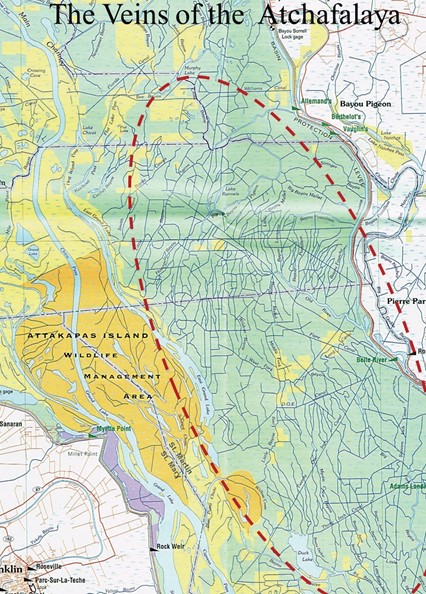
2004 Imagery of hundreds of miles of man-made canals (i.e., all straight lines are Man-Made made) Bayou Pigeon, Belle River, Grand Lake Vector.


Listed below are the recorded sites that I have identified in the Bayou Pigeon / Grand Lake vector.


The Trip to the La Montange:


The route to the Montange is via a swamp slough. The site is located on Big Bayou Pigeon. The exact location of The Montange is not given so as to protect it from unauthorized artifact seekers and vandals. Please note La Montange is located on private property.  It is against State law to remove artifacts from any archaeological site without authorization.


The trip resulted in the identification several pieces pottery shards and measurements of the approximate size of the shell midden and identification of shells on the mound. We used the format of the state archaeological records to record the info. Our results / info below, it will be used to update official site records.


Official State records, document the date the first visit to site 16IB8 was in 1937 by Kniffen and Beecher. 


Bayou Plaquemine Distributary System

Big Bayou Pigeon is considered part of the Bayou Plaquemine Distributary System. The prehistoric archaeological deposits of the Bayou Plaquemine Distributary System consist mostly of Rangia shell middens in a linear pattern along the natural levees of major waterways.  Earth mounds are also located primarily on the natural levees of the distributaries of this system.

The known archaeological sites associated with the Bayou Plaquemine Distributary System have been greatly impacted by natural processes, i.e., buried and / or partially covered up by sedimentation in the last 100 years.

The Montange, because of its location has not been affected as much as other site sin the area that are located on major waterway carrying heavy sedimentation during flood season.

Why is that?  The Montange may be located on old abandoned distributary between Little Bayou Pigeon and Big Bayou Pigeon.This would explain why it has been somewhat preserved from heavy sedimentation and why it seems to be out of place in the middle of the swamp.

The highest probability for finding artifacts are on archaeological sites in the Atchafalaya basin that are on the natural levees of extinct and extant distributaries in and around the basin

Who were the people to use this mound?

Site 16IB8 ( La Montage) exhibits pre historic Coles Creek culture and Plaquemines culture.

What are Coles Creek and Plaquemines culture?

The Coles Creek culture is the name given to sites created by a group of pottery-making Native Americans in Arkansas, Louisiana, Oklahoma and Texas, ca. AD 400 to 1100, ie, the designation prehistoric sites. The Plaquemine Culture (1100 to 1730) (Neuman and Servello 1976:19), developed out of Coles Creek in the Lower Mississippi Valley.

Note; The Chitimacha Indians  of  Louisiana probably developed out of this culture.  Most assemblages from the Atchafalaya Basin are representative of the Plaquemine Culture.


The cultural deposits were first recorded by Kniffen in 1937, are representative of the Coles Creek / Plaquemine period thus the Montange is likely associated with this time period, ie, up to the 1700’s of Louisiana history.


The Coles Creek / Plaquemines culture / people collected wild seeds, fruit, roots and other plant foods. They hunted but mostly fished to survive. Fish was their primary source of food.  At the time of Columbus’ discovery of America, historians estimate the combined strength of the Indians in Plaquemines Culture groups was about 20,000.


The probability of discovering  any new / newer archelogical sites is greatly lessened today due to the high sediment rate within the basin proper. This is why documenting and preserving the site 16IB8 The Mon_tan is important to history.

In the 1600’s and 1700’s there were three Indian tribes that were documented as having migrated through and/or having lived within the Atchafalaya Basin.  They were the Chitimacha, the Houma (Gibson 1982:88-89), and the Bayou Goula (Manning et al. 1987:30). Sometime before the 1700s, the Chitimacha’s moved north from the southern portion of the basin to Bayou Plaquemine area (Manning et al. 1987:3 1). Between the years 1706–18, the Chitimacha engaged in a long, bitter war with the French. The result was that the eastern Chitimacha were nearly wiped out. Those who survived were forced out by the European settlements. By 1730 they moved across the basin to the western branch of the Chitimacha Lakes (now Grand Lake) and along Bayou Teche (Gibson 1982:86

The existence of  the Montange ,Site 16IB, suggest that Bayou Pigeon could have been an east-west water route for the middle of the basin, use by the Chitimacha joining the Grand Lake village sites to villages along Bayou Plaquemine / Grosse Tete area.

On the Montange 2 14 2014 -  Master Outfitter / Guide/ Swamper  Anderson Hebert of Bayou Pigeon


Lloyd Hebert & Jim Delahoussaye on the Montange 2-14-2014 at the shell midden area


 Chachie & Jim on the Montange 2- 14 - 2014


Jim looking for artifacts


Shells and Pottery shards 2-14-2014


Pottery shards and shells on the north end of Mon_Tan 16IB8.  Shards with lines are more significant than those without markings. Note/fact: There are NO rocks in swamp sediment. The fact that the shards are there and the markings on them are not random are objective evidence that man put them there. Over 1,00 years old!!!


La Montange  - in the middle

In Conclusion:

The Atchafalaya Basin Floodway has experienced progressive basin wide vertical sedimentation for thousands of years and continues to do so. It is a natural process.  However, accelerated sedimentation of caused by man made activities in the last 100 years has greatly affected these pre historic sites, as evidenced by the historic filling of the Lake Chicot/ Grand Lake / Six mile system. In addition the activies of man   have scattered modern debris across some the sites, because they were high ridge areas conducive to living in the swamp.

La Montange is not in immediate danger of being buried by immediate vertical accretion of sediment, but it is obviously on a path for that to happen.  So far, the location, e.g., difficulty of access has protected the Montange from human debris scatter.

Thus it is important for us to document its existence and preserve it as long as we can. We pray that this blog post will be a little part of doing that.


In “Bayou Pigeon Spirit of the Atchafalaya” 

From Cliff (Chachie) LeGrange, Anderson (Gut) Hebert, Johnny (Jeremiah) Johnson, T-Lloyd Hebert and Jim Delahoussaye…

Enjoy!


Chachie and Jim Delahoussaye with a Cypress Drift on Mon_Tan - February 19, 2014


References:


The Louisiana and Arkansas Expeditions of Clarence Bloomfield Moore. Edited and With an Introduction by Richard A. Weinstein, David B. Kelley, and Joe W. Saunders. (Tuscaloosa: University Of Alabama Press, 2004. Pp. Ix, 676.

US Army Corps of Engineers, New Orleans District;
Historic Properties Management Plan for the Atchafalaya Basin floodway System Project, South Louisiana

Remote-sensing Survey of the Atchafalaya Basin Main Channel, Atchafalaya Channel Training Project, Sts. Martin and Mary Parishes, Louisiana; Cultural Resources Series
Il Report Number: Coelmn/Pd-90/11

Gemorphical Investigation of The Atchafalaya Basin, Technical Report Gl-63-3, Us Army Waterways Experiment Station

Phase I Cultural Resources Survey and Archeological Inventory of the Bayou Sorrel Lock Replacement Project Iberville Parish, Louisiana, Corp of Engineers,

Cultural Resources Survey of EABPL Offsite Borrow Areas, Levee Items E64 E76 and E84a Iberville Iberia and Assumption Parishes

Timothy M. Schilling
B.A., Louisiana State University, 2002
May 2004; Excavations at the Bayou Grande Cheniere mounds (16pl159): a Coles Creek period mound complex